
I thought eight metrics could capture my mental state. I was wrong.
Morning and night, I pronounce "Hey Exo" [1] , and my phone beeps once. I begin describing events and what's going on in my mind – where my attention is, my present feelings, how I slept, what I did that day, and who sleighted me – you know, that kind of stuff ;) Eventually, I begin listing various subjective quantitative measures, "Bipolar index: -1 to 0, Mood: +4, Stress: 3-4, Motivation: 5..." The resulting transcription is parsed by LLM and eventually makes it to a database table that can be plotted. I described the motivation for this and the process in greater detail yesterday. I log eight core metrics: bipolar index, mood, motivation, stress, anxiety, somnolence, % chance of falling asleep, and productivity. On occasion, I log other values such as "instability", tiredness, focus, mu
Morning and night, I pronounce "Hey Exo"[1], and my phone beeps once. I begin describing events and what's going on in my mind – where my attention is, my present feelings, how I slept, what I did that day, and who sleighted me – you know, that kind of stuff ;)
Eventually, I begin listing various subjective quantitative measures, "Bipolar index: -1 to 0, Mood: +4, Stress: 3-4, Motivation: 5..." The resulting transcription is parsed by LLM and eventually makes it to a database table that can be plotted.
I described the motivation for this and the process in greater detail yesterday.
I log eight core metrics: bipolar index, mood, motivation, stress, anxiety, somnolence, % chance of falling asleep, and productivity. On occasion, I log other values such as "instability", tiredness, focus, muscle soreness, and others. For each of these, I have a relatively precise definition, and for the core ones, something of a calibrated scale that I consider pretty consistent and repeatable despite them being subjective measures.
What I have found, though, is that eight metrics feels compressed and lossy, and the clean definitions I thought I had are inadequate.
All of the logging grew from the arch-metric: the Bipolar Index scale.
Years ago, I defined a personal bipolar index scale to communicate to myself and close ones my mental state.
My bipolar index ranges from -10 to +10 and is a subjective self-report. -10 would be a state of extreme suicidal depression. +10 would be extreme mania with complete loss of insight, delusions of grandeur, pressured speech, psychosis, etc. 0 is the perfectly balanced state in the middle, neither up nor down. - yesterday's post
Bipolar Index: -10 to +10Early in March, I began trying a new medication, which was destabilizing.
Where I am on the bipolar index has a component of gestalt feeling, but it does decompose into components. Prototypical mania is elevated mood, inability to sleep, agitation, decreased anxiety, and heightened motivation. Depression is the converse.
Yet, states with some symptoms and not others are the norm. Consequently, my logging habits grew from the initial Bipolar Index to the rest in order to capture things fully.
(I should perhaps write a post about the introspective epistemic challenges of bipolar disorder. Is my low mood because of unfortunate actual events, or an artefact of a non-epistemic brain state? Bipolar is a disorder of the mapping between external events and internal motions being a moving target.)
Mood (Affective Valence): -10 to +10
The Mood scale ranges from -10 to +10. Ideally, my mood would be +5 most of the time with appropriate deviations in response to good and bad events. I have recently decided that canonically, my Mood metric is the affective state of kind of how I feel. If you're a person who feels good after having a drink or two, that's the dimension of feeling good (or bad) that I'm talking about. It's not quite a feeling in my body, but it's kind of like a "feeling in my mind".
And yet, sometimes I feel shitty in brain and body, but still feel good about things. There's a mood dimension that is more cognitive, more predictive, and more anticipatory about the future. I think Outlook is a plausible label for it[2]. It captures how I feel about things – are things going well or poorly at the moment? Am I satisfied or dissatisfied?
The correlation between as felt-state and mood as outlook is high, but not perfect. Often, hope is what teases them apart: I've slept poorly, feel shitty, but something is on my mind that's giving me hope for improvement. Outlook can be good while feeling bad.
If I were willing to double my daily metric load, I'd separate these two facets of mood.
In fact, the split between cognitive state and affective felt state runs throughout the metrics. Exhibit B: Stress.
Physiological Stress: 0 to +10
When I log stress, I'm thinking about physiological stress. It feels like a tightness in my chest or breathing – very bodily. Scored 0 to +10. Ideal average is 0-2, actual average is 3-5. Stress is particularly frustrating to me in that my bodily felt stress typically feels higher than my "cognitive stress" assessment of how stressful my situation actually is.
I could log cognitive stress assessment, but it's easy for me to derive from my general non-quantitative records of what's happening. Right now, I'm content to derive it from that during analysis, that is, when I sit down and compare the graphs with events, etc.
Anxiety: 0 to +10
Distinct from Stress is Anxiety. For me, this is a different set of bodily feelings than Stress. I can't easily describe them, but I know them. Something, something chest tightness vs a feeling of adrenaline radiating out. (I could imagine someone else labeling things differently.) Same as Stress, Anxiety has a cognitive/predictive component. For me, that often takes some form of Insecurity: am I good enough? Am I adequate? These are thoughts typically accompanied by some visceral feeling, but again, they come apart.
% Chance of Falling Asleep (0-100%) & "Somnolence" (0 to +10)
God. I haven't carefully categorized them, but there are at least five distinct states of tiredness, sleepiness, sleep deprivation, sedation, grogginess, and exhaustion.
- The raw, healthy tiredness a person typically feels at the end of the day, sleep pressure building up as it should, in conjunction with your circadian rhythm.
- The feeling of sleep deprivation that I get from being overly tired. Unlike normal tiredness, it's unpleasant and can make it harder to fall asleep.
- The sedation of central nervous system depressants, such as sleeping pills and alcohol.
- The exhaustion due to physical exertion.
- [Bonus extra fun weeeee] The fatigue that accompanies bipolar down-states (and I assume regular depression too).
Some of these states feel like they're in my head, some in my body. I can feel like my mind is alert but my body is sleepy, and vice versa.
Bipolar fatigue sucks. I can feel like I'm well-rested on some dimension, but my brain doesn't want to work. Napping wouldn't actually help because I'm not tired in that way, and I'd expect to have trouble falling asleep in any case.
I'm not enthused by the idea of logging each of these kinds of "tiredness" twice daily. The existing batch of eight takes 2-10 minutes each time, and each metric does take a moment of introspection. Though I do separately describe the dominant feeling qualitatively for my logs, so the info is there, just I can't plot it.
My attempted compression of these multiple sleep dimensions is Somnolence and % Chance of falling asleep. I started with Somnolence as a general sense of tiredness, but quickly noticed Somnolence is inadequate for recording key states around insomnia and Bipolar state.
A thing that will happen to me sometimes is that I am extremely tired and somnolent, but am unable to sleep due to physiological stress[3]. Tired and wired, as they say. In practice, my actual percentage chance of falling asleep is the net effect of Somnolence and Stress in combination.
For now, I log the above two sleep metrics.
Oh! But even % chance of falling asleep is wanting when it comes to the insomnia story! I've noticed that I can both predict that I'll fall asleep and also that I'll not stay asleep – onset insomnia vs maintenance insomnia. The latter is likely if Stress and Somnolence are both high. (A bit of sleep relieves sleep pressure, and then Stress reasserts itself.)
Motivation (aka Initiation/Volition): 0 to +10
Ah, Motivation. Such a funny mental variable. Years ago, I observed that in a Bipolar down-state, I could be adequately rested such that tiredness was not the problem, but still find it enormously effortful to do things. I'd sit on the couch, desire milk from the fridge, but getting up and walking across the room would feel enormously effortful.
Low motivation is like if your mind has gone in the opposite direction from the direction it goes when you take a stimulant like coffee and Adderall.
I score motivation 0 to +10, with 5 to 7 being pretty ideal. Above that'd be due to mania (or maybe due to Adderall, which I have experimented with but now avoid).
I really hate low Motivation as a symptom. It feels distinctly "brain chemistry" and not tied to my explicit beliefs about the return and reward on actions[4].
The interplay of these mental states can make them and their sources hard to track. I'm primarily interested in Motivation as a symptom of abnormal brain state, e.g., owing to a Bipolar state or medication-induced state. Yet if I'm tired, I'll feel low Motivation for that simple old boring reason.
In general, tiredness (of which I have no shortage due to frequent insomnia) is a difficult confound for tracking my Bipolar state. Sleep deprivation makes me irritable, anxious, and stressed. It doesn't mean I've hit a Bipolar down state.
I've also realized that the Bipolar Index is wanting for capturing Bipolar state. First, I've found that often I'm really not sure whether I'm a little bit up or a little bit down, so I'll log -1 to +1, which averages to 0, but the state is distinctly not 0.
Second, there's a dimension of Bipolar Instability that I can feel, which is different from where I am on the index. Kind of like a derivative of the index, to invoke calculus. On occasion, I can feel that my mind is neither up nor down, but is sensitive and could easily be nudged in one direction or another. Conversely, I could be in a very stable at a -3 Bipolar down-state.
To be honest, I find tracking my mental states a bit tedious and dull, and this post feels a bit dry. I can take some satisfaction that a lot of science happened because people took copious, detailed notes – Bacon, Brahe, Darwin, Faraday, Hooke, and others – and I'm being part of that tradition.
But that's not why I'm doing this, really.
I'm doing it because there's so much fucking great stuff in life to do. So much value to be claimed. Very young, I realized I didn't want to get old and die because I wanted to try all the hobbies, read all the books, learn all the skills, have all the relationships, and so on. Not to mention it is perhaps the last decade when humans get to shape the trajectory of the cosmos, and I'd rather like to do more than less to make it turn out well.
Time feels limited and precious. I'm fucking sick of losing time and enjoyment to sucky brain states. Hence, the self-science above.
In this piece, I've described the measurements I take. In subsequent pieces, I'll talk more about what I'm comparing them against, namely: (a) the interventions I hope to improve outcomes, (b) attempts to figure out in greater mechanistic detail what's going wrong, as a clue to better interventions.
Interventions such as new drugs, biofeedback training, vagus nerve toning, and circadian rhythm entrainment. Mechanistic investigations such as detailed genome analysis, cortisol level measurements, and tracking inflammatory cytokines throughout different points in my mental fluctuations.
- ^
Short for Exobrain.
- ^
I think I got this from Hardwiring Happiness, though I read it in 2014.
- ^
A cruel reality I'm working on is that I get stressed out by insomnia. Thanks, brain.
- ^
It is very much the case that Bipolar up-states bias predictions of success and reward upwards, and can drive feelings of Motivation very high.
- ^
Lack of sleep, too much sleep, good news, bad news, stress, etc. It sucks to be vulnerable to too much good news as a destabilizer.
lesswrong.com
https://www.lesswrong.com/posts/vfzRb2fLczG3BXZDC/i-thought-eight-metrics-could-capture-my-mental-state-i-wasSign in to highlight and annotate this article

Conversation starters
Daily AI Digest
Get the top 5 AI stories delivered to your inbox every morning.
More about
trainingproductanalysis
A Tale of Two Rigours
A familiarity with the pre-rigor/post-rigor ontology might be helpful for reading this post. University math is often sold to students as imbuing in them the spirit of rigor and respect for iron-clad truth. The value in a real analysis course comes not from the specific results that it teaches — those are largely known to scientifically literate students by the time they take it. Instead, they are asked to relearn all those things from first principles; in so doing, they strip themselves of bad habits they previously learned and are inducted into the skeptical culture of the mathematician. Pedagogical and exam materials usually support this goal, putting emphasis on proof-writing, careful argumentation and attention to detail. This incentivises the student to cultivate an invaluable attitu
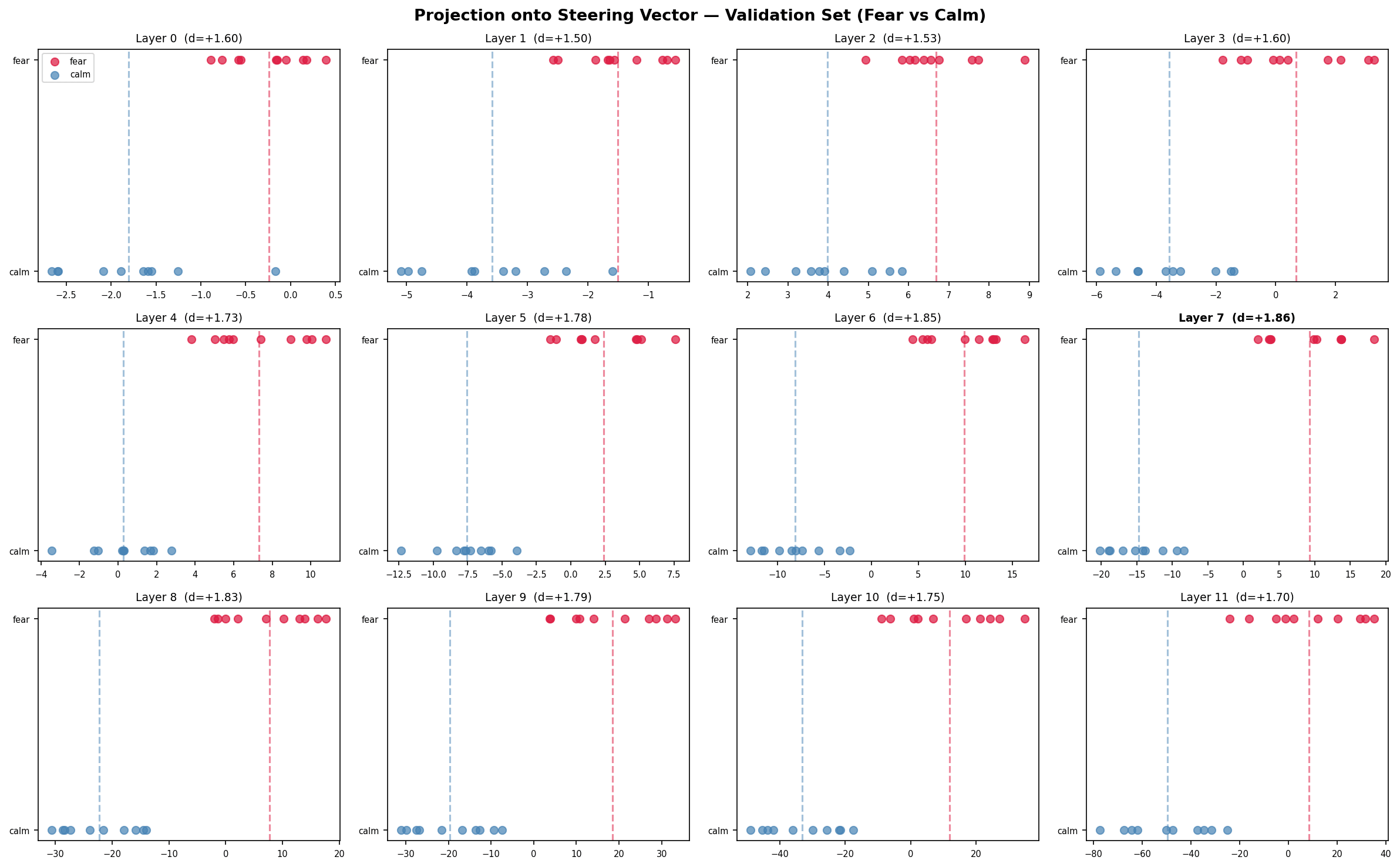
Does GPT-2 Have a Fear Direction?
Anthropic dropped a paper this morning showing that Claude Sonnet 4.5 has steerable emotion representations. Actual directions in activation space that, when injected, shift the model's behavior in predictable ways. They found a non-monotonic anger flip: push the steering vector hard enough and the model will flip to something qualitatively different than anger. The paper only covered their very large, heavily instruction tuned model. This paper is a write-up on the same same experiment at a tiny scale. The Setup: I generated 40 situational prompt pairs to extract a fewer direction via difference-in-means. No emotional words for the prompts and the contrast is entirely situational. Ex: standing at the edge of a rooftop versus standing at the edge of a meadow, alone in a parking garage at m

Knowledge Map
Connected Articles — Knowledge Graph
This article is connected to other articles through shared AI topics and tags.
More in Analyst News

A Tale of Two Rigours
A familiarity with the pre-rigor/post-rigor ontology might be helpful for reading this post. University math is often sold to students as imbuing in them the spirit of rigor and respect for iron-clad truth. The value in a real analysis course comes not from the specific results that it teaches — those are largely known to scientifically literate students by the time they take it. Instead, they are asked to relearn all those things from first principles; in so doing, they strip themselves of bad habits they previously learned and are inducted into the skeptical culture of the mathematician. Pedagogical and exam materials usually support this goal, putting emphasis on proof-writing, careful argumentation and attention to detail. This incentivises the student to cultivate an invaluable attitu

Discussion
Sign in to join the discussion
No comments yet — be the first to share your thoughts!