
Why Momentum Really Works
Momentum optimization, often visualized as a ball rolling downhill, is a more complex process than this simple analogy suggests. While the basic concept holds, there are deeper mechanisms at play that contribute to its effectiveness in machine learning. Understanding these additional factors provides a more complete picture of why momentum truly works.
Step-size α = 0.02
Momentum β = 0.99
We often think of Momentum as a means of dampening oscillations and speeding up the iterations, leading to faster convergence. But it has other interesting behavior. It allows a larger range of step-sizes to be used, and creates its own oscillations. What is going on?
April. 4
2017
Citation:
Goh, 2017
Here’s a popular story about momentum [1, 2, 3]: gradient descent is a man walking down a hill. He follows the steepest path downwards; his progress is slow, but steady. Momentum is a heavy ball rolling down the same hill. The added inertia acts both as a smoother and an accelerator, dampening oscillations and causing us to barrel through narrow valleys, small humps and local minima.
This standard story isn’t wrong, but it fails to explain many important behaviors of momentum. In fact, momentum can be understood far more precisely if we study it on the right model.
One nice model is the convex quadratic. This model is rich enough to reproduce momentum’s local dynamics in real problems, and yet simple enough to be understood in closed form. This balance gives us powerful traction for understanding this algorithm.
We begin with gradient descent. The algorithm has many virtues, but speed is not one of them. It is simple — when optimizing a smooth function
ff, we make a small step in the gradient
wk+1=wk−α∇f(wk).w^{k+1} = w^k-\alpha\nabla f(w^k).
For a step-size small enough, gradient descent makes a monotonic improvement at every iteration. It always converges, albeit to a local minimum. And under a few weak curvature conditions it can even get there at an exponential rate.
But the exponential decrease, though appealing in theory, can often be infuriatingly small. Things often begin quite well — with an impressive, almost immediate decrease in the loss. But as the iterations progress, things start to slow down. You start to get a nagging feeling you’re not making as much progress as you should be. What has gone wrong?
The problem could be the optimizer’s old nemesis, pathological curvature. Pathological curvature is, simply put, regions of
ff which aren’t scaled properly. The landscapes are often described as valleys, trenches, canals and ravines. The iterates either jump between valleys, or approach the optimum in small, timid steps. Progress along certain directions grind to a halt. In these unfortunate regions, gradient descent fumbles.
Momentum proposes the following tweak to gradient descent. We give gradient descent a short-term memory:
zk+1=βzk+∇f(wk)wk+1=wk−αzk+1 \begin{aligned} z^{k+1}&=\beta z^{k}+\nabla f(w^{k})\[0.4em] w^{k+1}&=w^{k}-\alpha z^{k+1} \end{aligned}
The change is innocent, and costs almost nothing. When
β=0\beta = 0 , we recover gradient descent. But for
β=0.99\beta = 0.99 (sometimes
0.9990.999, if things are really bad), this appears to be the boost we need. Our iterations regain that speed and boldness it lost, speeding to the optimum with a renewed energy.
Optimizers call this minor miracle “acceleration”.
The new algorithm may seem at first glance like a cheap hack. A simple trick to get around gradient descent’s more aberrant behavior — a smoother for oscillations between steep canyons. But the truth, if anything, is the other way round. It is gradient descent which is the hack. First, momentum gives up to a quadratic speedup on many functions. 1 This is no small matter — this is similar to the speedup you get from the Fast Fourier Transform, Quicksort, and Grover’s Algorithm. When the universe gives you quadratic speedups, you should start to pay attention.
But there’s more. A lower bound, courtesy of Nesterov [5], states that momentum is, in a certain very narrow and technical sense, optimal. Now, this doesn’t mean it is the best algorithm for all functions in all circumstances. But it does satisfy some curiously beautiful mathematical properties which scratch a very human itch for perfection and closure. But more on that later. Let’s say this for now — momentum is an algorithm for the book.
First Steps: Gradient Descent
We begin by studying gradient descent on the simplest model possible which isn’t trivial — the convex quadratic,
f(w)=12wTAw−bTw,w∈Rn. f(w) = \tfrac{1}{2}w^TAw - b^Tw, \qquad w \in \mathbf{R}^n.
Assume
AA is symmetric and invertible, then the optimal solution
w⋆w^{\star} occurs at
w⋆=A−1b. w^{\star} = A^{-1}b.
Simple as this model may be, it is rich enough to approximate many functions (think of
AA as your favorite model of curvature — the Hessian, Fisher Information Matrix [6], etc) and captures all the key features of pathological curvature. And more importantly, we can write an exact closed formula for gradient descent on this function.
This is how it goes. Since
∇f(w)=Aw−b\nabla f(w)=Aw - b, the iterates are
wk+1=wk−α(Awk−b). w^{k+1}=w^{k}- \alpha (Aw^{k} - b).
Here’s the trick. There is a very natural space to view gradient descent where all the dimensions act independently — the eigenvectors of
AA.
Every symmetric matrix
AA has an eigenvalue decomposition
A=Q diag(λ1,…,λn) QT,Q=[q1,…,qn], A=Q\ \text{diag}(\lambda_{1},\ldots,\lambda_{n})\ Q^{T},\qquad Q = [q_1,\ldots,q_n],
and, as per convention, we will assume that the
λi\lambda_i’s are sorted, from smallest
λ1\lambda_1 to biggest
λn\lambda_n. If we perform a change of basis,
xk=QT(wk−w⋆)x^{k} = Q^T(w^{k} - w^\star), the iterations break apart, becoming:
xik+1=xik−αλixik=(1−αλi)xik=(1−αλi)k+1xi0 \begin{aligned} x_{i}^{k+1} & =x_{i}^{k}-\alpha \lambda_ix_{i}^{k} \[0.4em] &= (1-\alpha\lambda_i)x^k_i=(1-\alpha \lambda_i)^{k+1}x^0_i \end{aligned}_
Moving back to our original space
ww, we can see that
wk−w⋆=Qxk=∑inxi0(1−αλi)kqi w^k - w^\star = Qx^k=\sum_i^n x^0_i(1-\alpha\lambda_i)^k q_i
and there we have it — gradient descent in closed form.
Decomposing the Error
The above equation admits a simple interpretation. Each element of
x0x^0 is the component of the error in the initial guess in the
QQ-basis. There are
nn such errors, and each of these errors follows its own, solitary path to the minimum, decreasing exponentially with a compounding rate of
1−αλi1-\alpha\lambda_i. The closer that number is to
11, the slower it converges.
For most step-sizes, the eigenvectors with largest eigenvalues converge the fastest. This triggers an explosion of progress in the first few iterations, before things slow down as the smaller eigenvectors’ struggles are revealed. By writing the contributions of each eigenspace’s error to the loss
f(wk)−f(w⋆)=∑(1−αλi)2kλi[xi0]2 f(w^{k})-f(w^{\star})=\sum(1-\alpha\lambda_{i})^{2k}\lambda_{i}[x_{i}^{0}]^2_
we can visualize the contributions of each error component to the loss.
Optimization can be seen as combination of several component problems, shown here as 1 2 3 with eigenvalues
λ1=0.01\lambda_1=0.01,
λ2=0.1\lambda_2=0.1, and
λ3=1\lambda_3=1 respectively.
Step-size
Optimal Step-size
Choosing A Step-size
The above analysis gives us immediate guidance as to how to set a step-size
α\alpha. In order to converge, each
∣1−αλi∣|1-\alpha \lambda_i| must be strictly less than 1. All workable step-sizes, therefore, fall in the interval
0<αλi<2.0<\alpha\lambda_i<2.
The overall convergence rate is determined by the slowest error component, which must be either
λ1\lambda_1 or
λn\lambda_n:
rate(α) = maxi∣1−αλi∣ = max{∣1−αλ1∣, ∣1−αλn∣}
\begin{aligned}\text{rate}(\alpha) & = \max_{i}\left|1-\alpha\lambda_{i}\right|\[0.9em] & = \max\left{|1-\alpha\lambda_{1}|,~ |1-\alpha\lambda_{n}|\right} \end{aligned}
This overall rate is minimized when the rates for
λ1\lambda_1 and
λn\lambda_n are the same — this mirrors our informal observation in the previous section that the optimal step-size causes the first and last eigenvectors to converge at the same rate. If we work this through we get:
optimal α = argminα rate(α) = 2λ1+λnoptimal rate = minα rate(α) = λn/λ1−1λn/λ1+1
\begin{aligned}
\text{optimal }\alpha ={\mathop{\text{argmin}}\limits_\alpha} ~\text{rate}(\alpha) & =\frac{2}{\lambda_{1}+\lambda_{n}}\[1.4em]
\text{optimal rate} ={\min_\alpha} ~\text{rate}(\alpha) & =\frac{\lambda_{n}/\lambda_{1}-1}{\lambda_{n}/\lambda_{1}+1}
\end{aligned}
Notice the ratio
λn/λ1\lambda_n/\lambda_1 determines the convergence rate of the problem. In fact, this ratio appears often enough that we give it a name, and a symbol — the condition number.
condition number:=κ:=λnλ1 \text{condition number} := \kappa :=\frac{\lambda_n}{\lambda_1}
The condition number means many things. It is a measure of how close to singular a matrix is. It is a measure of how robust
A−1bA^{-1}b is to perturbations in
bb. And, in this context, the condition number gives us a measure of how poorly gradient descent will perform. A ratio of
κ=1\kappa = 1 is ideal, giving convergence in one step (of course, the function is trivial). Unfortunately the larger the ratio, the slower gradient descent will be. The condition number is therefore a direct measure of pathological curvature.
Example: Polynomial Regression
The above analysis reveals an insight: all errors are not made equal. Indeed, there are different kinds of errors,
nn to be exact, one for each of the eigenvectors of
AA. And gradient descent is better at correcting some kinds of errors than others. But what do the eigenvectors of
AA mean? Surprisingly, in many applications they admit a very concrete interpretation.
Lets see how this plays out in polynomial regression. Given 1D data,
ξi\xi_i, our problem is to fit the model
model(ξ)=w1p1(ξ)+⋯+wnpn(ξ)pi=ξ↦ξi−1 \text{model}(\xi)=w_{1}p_{1}(\xi)+\cdots+w_{n}p_{n}(\xi)\qquad p_{i}=\xi\mapsto\xi^{i-1}_
to our observations,
did_i. This model, though nonlinear in the input
ξ\xi, is linear in the weights, and therefore we can write the model as a linear combination of monomials, like:
Because of the linearity, we can fit this model to our data
ξi\xi_i using linear regression on the model mismatch
minimizew12∑i(model(ξi)−di)2 = 12∥Zw−d∥2
\text{minimize}w \qquad\tfrac{1}{2}\sum_i (\text{model}(\xi{i})-d_{i})^{2} = \tfrac{1}{2}|Zw - d|^2_
where
Z=(1ξ1ξ12…ξ1n−11ξ2ξ22…ξ2n−1⋮⋮⋮⋱⋮1ξmξm2…ξmn−1). Z=\left(\begin{array}{ccccc} 1 & \xi_{1} & \xi_{1}^{2} & \ldots & \xi_{1}^{n-1}\ 1 & \xi_{2} & \xi_{2}^{2} & \ldots & \xi_{2}^{n-1}\ \vdots & \vdots & \vdots & \ddots & \vdots\ 1 & \xi_{m} & \xi_{m}^{2} & \ldots & \xi_{m}^{n-1} \end{array}\right)._
The path of convergence, as we know, is elucidated when we view the iterates in the space of
QQ (the eigenvectors of
ZTZZ^T Z). So let’s recast our regression problem in the basis of
QQ. First, we do a change of basis, by rotating
ww into
QwQw, and counter-rotating our feature maps
pp into eigenspace,
p¯\bar{p}. We can now conceptualize the same regression as one over a different polynomial basis, with the model
model(ξ) = x1p¯1(ξ) + ⋯ + xnp¯n(ξ)p¯i=∑qijpj.
\text{model}(\xi)=\cdots~+~x_{n}\bar{p}{n}(\xi)\qquad \bar{p}{i}=\sum q_{ij}p_j.x_{1}\bar{p}_{1}(\xi)+
This model is identical to the old one. But these new features
p¯\bar{p} (which I call “eigenfeatures”) and weights have the pleasing property that each coordinate acts independently of the others. Now our optimization problem breaks down, really, into
nn small 1D optimization problems. And each coordinate can be optimized greedily and independently, one at a time in any order, to produce the final, global, optimum. The eigenfeatures are also much more informative:
The observations in the above diagram can be justified mathematically. From a statistical point of view, we would like a model which is, in some sense, robust to noise. Our model cannot possibly be meaningful if the slightest perturbation to the observations changes the entire model dramatically. And the eigenfeatures, the principal components of the data, give us exactly the decomposition we need to sort the features by its sensitivity to perturbations in
did_i’s. The most robust components appear in the front (with the largest eigenvalues), and the most sensitive components in the back (with the smallest eigenvalues).
This measure of robustness, by a rather convenient coincidence, is also a measure of how easily an eigenspace converges. And thus, the “pathological directions” — the eigenspaces which converge the slowest — are also those which are most sensitive to noise! So starting at a simple initial point like
00 (by a gross abuse of language, let’s think of this as a prior), we track the iterates till a desired level of complexity is reached. Let’s see how this plays out in gradient descent.
This effect is harnessed with the heuristic of early stopping : by stopping the optimization early, you can often get better generalizing results. Indeed, the effect of early stopping is very similar to that of more conventional methods of regularization, such as Tikhonov Regression. Both methods try to suppress the components of the smallest eigenvalues directly, though they employ different methods of spectral decay.2 But early stopping has a distinct advantage. Once the step-size is chosen, there are no regularization parameters to fiddle with. Indeed, in the course of a single optimization, we have the entire family of models, from underfitted to overfitted, at our disposal. This gift, it seems, doesn’t come at a price. A beautiful free lunch [7] indeed.
The Dynamics of Momentum
Let’s turn our attention back to momentum. Recall that the momentum update is
zk+1=βzk+∇f(wk)wk+1=wk−αzk+1. \begin{aligned} z^{k+1}&=\beta z^{k}+\nabla f(w^{k})\[0.4em] w^{k+1}&=w^{k}-\alpha z^{k+1}. \end{aligned}
Since
∇f(wk)=Awk−b\nabla f(w^k) = Aw^k - b, the update on the quadratic is
zk+1=βzk+(Awk−b)wk+1=wk−αzk+1. \begin{aligned} z^{k+1}&=\beta z^{k}+ (Aw^{k}-b)\[0.4em] w^{k+1}&=w^{k}-\alpha z^{k+1}. \end{aligned}
Following [8], we go through the same motions, with the change of basis
xk=Q(wk−w⋆) x^{k} = Q(w^{k} - w^\star) and
yk=Qzk y^{k} = Qz^{k}, to yield the update rule
yik+1=βyik+λixikxik+1=xik−αyik+1. \begin{aligned} y_{i}^{k+1}&=\beta y_{i}^{k}+\lambda_{i}x_{i}^{k}\[0.4em] x_{i}^{k+1}&=x_{i}^{k}-\alpha y_{i}^{k+1}. \end{aligned}_
in which each component acts independently of the other components (though
xikx^k_i and
yiky^k_i are coupled). This lets us rewrite our iterates as
3
(yikxik)=Rk(yi0xi0)R=(βλi−αβ1−αλi). \left(!!\begin{array}{c} y_{i}^{k}\ x_{i}^{k} \end{array}!!\right)=R^k\left(!!\begin{array}{c} y_{i}^{0}\ x_{i}^{0} \end{array}!!\right) \qquad R = \left(!!\begin{array}{cc} \beta & \lambda_{i}\ -\alpha\beta & 1-\alpha\lambda_{i} \end{array}!!\right).
There are many ways of taking a matrix to the
kthk^{th} power. But for the
2×22 \times 2 case there is an elegant and little known formula [9] in terms of the eigenvalues of
RR,
σ1\sigma_1 and
σ2\sigma_2.
Rk={σ1kR1−σ2kR2σ1≠σ2σ1k(kR/σ1−(k−1)I)σ1=σ2,Rj=R−σjIσ1−σ2 \color{#AAA}{\color{black}{R^{k}}=\begin{cases} \color{black}{\sigma_{1}^{k}}R_{1}-\color{black}{\sigma_{2}^{k}}R_{2} & \sigma_{1}\neq\sigma_{2}\ \sigma_{1}^{k}(kR/\sigma_1-(k-1)I) & \sigma_{1}=\sigma_{2} \end{cases},\qquad R_{j}=\frac{R-\sigma_{j}I}{\sigma_{1}-\sigma_{2}}}_
This formula is rather complicated, but the takeaway here is that it plays the exact same role the individual convergence rates,
1−αλi1-\alpha\lambda_i do in gradient descent. But instead of one geometric series, we have two coupled series, which may have real or complex values. The convergence rate is therefore the slowest of the two rates,
max{∣σ1∣,∣σ2∣}\max{|\sigma_{1}|,|\sigma_{2}|} 4. By plotting this out, we see there are distinct regions of the parameter space which reveal a rich taxonomy of convergence behavior [10]:
Convergence Rate
A plot of
max{∣σ1∣,∣σ2∣}\max{|\sigma_1|, |\sigma_2|} reveals distinct regions, each with its own style of convergence.
For what values of
α\alpha and
β\beta does momentum converge? Since we need both
σ1\sigma_1 and
σ2\sigma_2 to converge, our convergence criterion is now
max{∣σ1∣,∣σ2∣}<1\max{|\sigma_{1}|,|\sigma_{2}|} < 1. The range of available step-sizes work out 5 to be
0<αλi<2+2βfor0≤β<10<\alpha\lambda_{i}<2+2\beta \qquad \text{for} \qquad 0 \leq \beta < 1_
We recover the previous result for gradient descent when
β=0\beta = 0. But notice an immediate boon we get. Momentum allows us to crank up the step-size up by a factor of 2 before diverging.
The Critical Damping Coefficient
The true magic happens, however, when we find the sweet spot of
α\alpha and
β\beta. Let us try to first optimize over
β\beta.
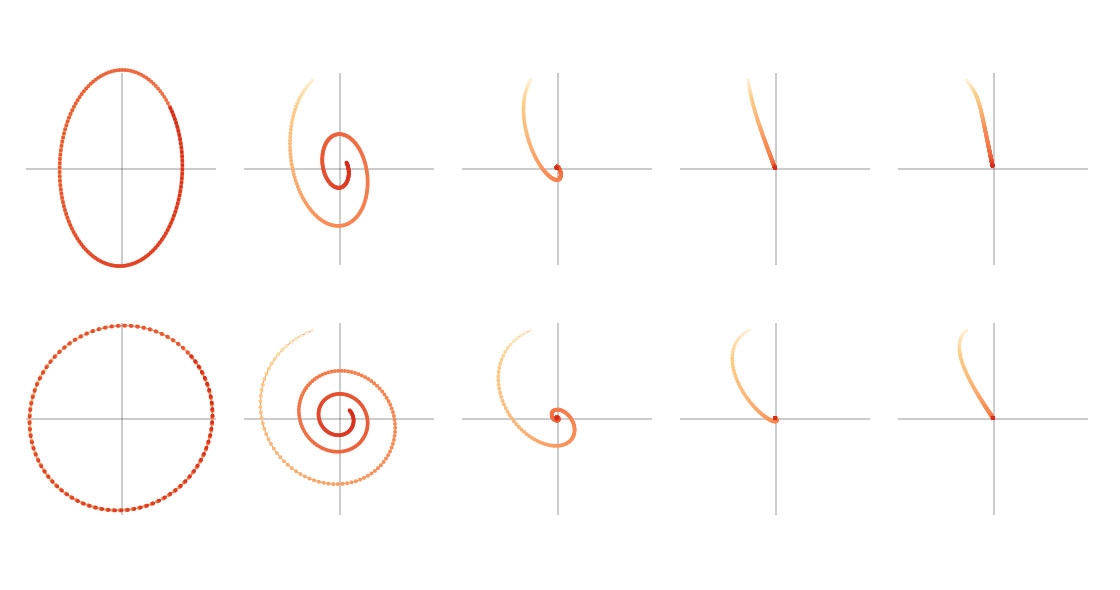
Momentum admits an interesting physical interpretation when
α\alpha is [11] small: it is a discretization of a damped harmonic oscillator. Consider a physical simulation operating in discrete time (like a video game).
yik+1y_{i}^{k+1}_
==
++
λixik\lambda_{i}x_{i}^{k}
and perturbed by an external force field
We can think of
−yik-y_i^k as velocity
βyik\beta y_{i}^{k}_
which is dampened at each step
xik+1x_i^{k+1}
==
xik−αyik+1x_i^k - \alpha y_i^{k+1}
And
xx is our particle’s position
which is moved at each step by a small amount in the direction of the velocity
yik+1y^{k+1}i.
We can break this equation apart to see how each component affects the dynamics of the system. Here we plot, for
150150 iterates, the particle’s velocity (the horizontal axis) against its position (the vertical axis), in a phase diagram.
This system is best imagined as a weight suspended on a spring. We pull the weight down by one unit, and we study the path it follows as it returns to equilibrium. In the analogy, the spring is the source of our external force
λixik\lambda_ix^k_i, and equilibrium is the state when both the position
xikx^k_i and the speed
yiky^k_i are 0. The choice of
β\beta crucially affects the rate of return to equilibrium.
The critical value of
β=(1−αλi)2\beta = (1 - \sqrt{\alpha \lambda_i})^2 gives us a convergence rate (in eigenspace
ii) of
1−αλi.1 - \sqrt{\alpha\lambda_i}. A square root improvement over gradient descent,
1−αλi1-\alpha\lambda_i! Alas, this only applies to the error in the
ithi^{th} eigenspace, with
α\alpha fixed.
Optimal parameters
To get a global convergence rate, we must optimize over both
α\alpha and
β\beta. This is a more complicated affair,6 but they work out to be
α=(2λ1+λn)2β=(λn−λ1λn+λ1)2 \alpha = \left(\frac{2}{\sqrt{\lambda_{1}}+\sqrt{\lambda_{n}}}\right)^{2} \quad \beta = \left(\frac{\sqrt{\lambda_{n}}-\sqrt{\lambda_{1}}}{\sqrt{\lambda_{n}}+\sqrt{\lambda_{1}}}\right)^{2}
Plug this into the convergence rate, and you get
κ−1κ+1\frac{\sqrt{\kappa}-1}{\sqrt{\kappa}+1}
Convergence rate, Momentum
κ−1κ+1 \frac{\kappa-1}{\kappa+1}
Convergence rate, Gradient Descent
With barely a modicum of extra effort, we have essentially square rooted the condition number! These gains, in principle, require explicit knowledge of
λ1\lambda_1 and
λn\lambda_n. But the formulas reveal a simple guideline. When the problem’s conditioning is poor, the optimal
α\alpha is approximately twice that of gradient descent, and the momentum term is close to
- So set
β\beta as close to
11 as you can, and then find the highest
α\alpha which still converges. Being at the knife’s edge of divergence, like in gradient descent, is a good place to be.
We can do the same decomposition here with momentum, with eigenvalues
λ1=0.01\lambda_1=0.01,
λ2=0.1\lambda_2=0.1, and
λ3=1\lambda_3=1. Though the decrease is no longer monotonic, but significantly faster.
f(wk)−f(w⋆)f(w^k) - f(w^\star) Note that the optimal parameters do not necessarily imply the fastest convergence, though, only the fastest asymptotic convergence rate.
Step-size α =
Momentum β =
While the loss function of gradient descent had a graceful, monotonic curve, optimization with momentum displays clear oscillations. These ripples are not restricted to quadratics, and occur in all kinds of functions in practice. They are not cause for alarm, but are an indication that extra tuning of the hyperparameters is required.
Example: The Colorization Problem
Let’s look at how momentum accelerates convergence with a concrete example. On a grid of pixels let
GG be the graph with vertices as pixels,
EE be the set of edges connecting each pixel to its four neighboring pixels, and
DD be a small set of a few distinguished vertices. Consider the problem of minimizing
minimize\text{minimize}
12∑i∈D(wi−1)2\qquad \frac{1}{2} \sum_{i\in D} (w_i - 1)^2_
The colorizer pulls distinguished pixels towards 1
++
12∑i,j∈E(wi−wj)2.\frac{1}{2} \sum_{i,j\in E} (w_i - w_j)^2._
The smoother spreads out the color
The optimal solution to this problem is a vector of all
11’s 7. An inspection of the gradient iteration reveals why we take a long time to get there. The gradient step, for each component, is some form of weighted average of the current value and its neighbors:
wik+1=wik−α∑j∈N(wik−wjk)−{α(wik−1)i∈D0i∉D w_{i}^{k+1}=w_{i}^{k}-\alpha\sum_{j\in N}(w_{i}^{k}-w_{j}^{k})-\begin{cases} \alpha(w_{i}^{k}-1) & i\in D\ 0 & i\notin D \end{cases}
This kind of local averaging is effective at smoothing out local variations in the pixels, but poor at taking advantage of global structure. The updates are akin to a drop of ink, diffusing through water. Movement towards equilibrium is made only through local corrections and so, left undisturbed, its march towards the solution is slow and laborious. Fortunately, momentum speeds things up significantly.
The eigenvectors of the colorization problem form a generalized Fourier basis for
RnR^n. The smallest eigenvalues have low frequencies, hence gradient descent corrects high frequency errors well but not low frequency ones.
In vectorized form, the colorization problem is
minimize\text{minimize}
The smoother’s quadratic form is the Graph Laplacian
12∑i∈D(xTeieiTx−eiTx)\frac{1}{2}\sum_{i\in D}\left(x^{T}e_{i}e_{i}^{T}x-e_{i}^{T}x\right)
++
12xTLGx\frac{1}{2}x^{T}L_{G}x_
And the colorizer is a small low rank correction with a linear term.
eie_i is the
ithi^{th} unit vector.
The Laplacian matrix,
LGL_G 8, which dominates the behavior of the optimization problem, is a valuable bridge between linear algebra and graph theory. This is a rich field of study, but one fact is pertinent to our discussion here. The conditioning of
LGL_G, here defined as the ratio of the second eigenvector to the last (the first eigenvalue is always 0, with eigenvector equal to the matrix of all 1′s), is directly connected to the connectivity of the graph.
Small world graphs, like expanders and dense graphs, have excellent conditioning
The conditioning of grids improves with its dimensionality.
And long, wiry graphs, like paths, condition poorly.
These observations carry through to the colorization problem, and the intuition behind it should be clear. Well connected graphs allow rapid diffusion of information through the edges, while graphs with poor connectivity do not. And this principle, taken to the extreme, furnishes a class of functions so hard to optimize they reveal the limits of first order optimization.
The Limits of Descent
Let’s take a step back. We have, with a clever trick, improved the convergence of gradient descent by a quadratic factor with the introduction of a single auxiliary sequence. But is this the best we can do? Could we improve convergence even more with two sequences? Could one perhaps choose the
α\alpha’s and
β\beta’s intelligently and adaptively? It is tempting to ride this wave of optimism - to the cube root and beyond!
Unfortunately, while improvements to the momentum algorithm do exist, they all run into a certain, critical, almost inescapable lower bound.
Adventures in Algorithmic Space
To understand the limits of what we can do, we must first formally define the algorithmic space in which we are searching. Here’s one possible definition. The observation we will make is that both gradient descent and momentum can be “unrolled”. Indeed, since
w1=w0 − α∇f(w0)w2=w1 − α∇f(w1)=w0 − α∇f(w0) − α∇f(w1) ⋮wk+1=w0 − α∇f(w0) − ⋯⋯ − α∇f(wk)
\begin{array}{lll}
w^{1} & != & !w^{0} - \alpha\nabla f(w^{0})\[0.35em]
w^{2} & != & !w^{1} - \alpha\nabla f(w^{1})\[0.35em]
& != & !w^{0} - \alpha\nabla f(w^{0}) - \alpha\nabla f(w^{1})\[0.35em]
& ~ !\vdots \
w^{k+1} & != & !w^{0} - \alpha\nabla f(w^{0}) -~~~~ \cdots\cdots ~~~~- \alpha\nabla f(w^{k})
\end{array}
we can write gradient descent as
wk+1 = w0 − α∑ik∇f(wi).
w^{k+1} = w^{0} - \alpha\sum_i^k\nabla f(w^{i}).
A similar trick can be done with momentum:
wk+1 = w0 + α∑ik(1−βk+1−i)1−β∇f(wi).
w^{k+1} = w^{0} + \alpha\sum_i^k\frac{(1-\beta^{k+1-i})}{1-\beta}\nabla f(w^i).
In fact, all manner of first order algorithms, including the Conjugate Gradient algorithm, AdaMax, Averaged Gradient and more, can be written (though not quite so neatly) in this unrolled form. Therefore the class of algorithms for which
wk+1 = w0 + ∑ikγik∇f(wi) for some γik
w^{k+1} = w^{0} + \sum_{i}^{k}\gamma_{i}^{k}\nabla f(w^{i}) \qquad \text{ for some } \gamma_{i}^{k}_
contains momentum, gradient descent and a whole bunch of other algorithms you might dream up. This is what is assumed in Assumption 2.1.4 [5] of Nesterov. But let’s push this even further, and expand this class to allow different step-sizes for different directions.
wk+1 = w0 + ∑ikΓik∇f(wi) for some diagonal matrix Γik.
w^{k+1} = w^{0} + \sum_{i}^{k}\Gamma_{i}^{k}\nabla f(w^{i}) \quad \text{ for some diagonal matrix } \Gamma_{i}^{k} ._
This class of methods covers most of the popular algorithms for training neural networks, including ADAM and AdaGrad. We shall refer to this class of methods as “Linear First Order Methods”, and we will show a single function all these methods ultimately fail on.
The Resisting Oracle
Earlier, when we talked about the colorizer problem, we observed that wiry graphs cause bad conditioning in our optimization problem. Taking this to its extreme, we can look at a graph consisting of a single path — a function so badly conditioned that Nesterov called a variant of it “the worst function in the world”. The function follows the same structure as the colorizer problem, and we shall call this the Convex Rosenbrock,
fn(w)f^n(w)
==
with a colorizer of one node
12(w1−1)2\frac{1}{2}\left(w_{1}-1\right)^{2}_
++
12∑i=1n(wi−wi+1)2\frac{1}{2}\sum_{i=1}^{n}(w_{i}-w_{i+1})^{2}_
strong couplings of adjacent nodes in the path,
++
2κ−1∥w∥2.\frac{2}{\kappa-1}|w|^{2}.
and a small regularization term.
The optimal solution of this problem is
wi⋆=(κ−1κ+1)i w_{i}^{\star}=\left(\frac{\sqrt{\kappa}-1}{\sqrt{\kappa}+1}\right)^{i}_
and the condition number of the problem
fnf^n approaches
κ\kappa as
nn goes to infinity. Now observe the behavior of the momentum algorithm on this function, starting from
w0=0w^0 = 0.
Step-size α =
Momentum β =
Here we see the first 50 iterates of momentum on the Convex Rosenbrock for
n=25n=25. The behavior here is similar to that of any Linear First Order Algorithm.
This triangle is a “dead zone” of our iterates. The iterates are always 0, no matter what the parameters. The remaining expanding space is the “light cone” of our iterate’s influence. Momentum does very well here with the optimal parameters.
Error
Weights
The observations made in the above diagram are true for any Linear First Order algorithm. Let us prove this. First observe that each component of the gradient depends only on the values directly before and after it:
∇f(x)i=2wi−wi−1−wi+1+4κ−1wi,i≠1. \nabla f(x){i}=2w{i}-w_{i-1}-w_{i+1} +\frac{4}{\kappa-1} w_{i}, \qquad i \neq 1._
Therefore the fact we start at 0 guarantees that that component must remain stoically there till an element either before or after it turns nonzero. And therefore, by induction, for any linear first order algorithm,
w0=[ 0,0,0,…0,0,…0 ]w1=[ w11,0,0,…0,0,…0 ]w2=[ w12,w22,0,…0,0,…0 ] ⋮wk=[ w1k,w2k,w3k,…wkk,0,…0 ].
\begin{array}{lllllllll}
w^{0} & = & [~~0, & 0, & 0, & \ldots & 0, & 0, & \ldots & 0~]\[0.35em]
w^{1} & = & [w_{1}^{1}, & 0, & 0, & \ldots & 0, & 0, & \ldots & 0]\[0.35em]
w^{2} & = & [w_{1}^{2}, & w_{2}^{2}, & 0, & \ldots & 0, & 0, & \ldots & 0]\[0.35em]
& ~ \vdots \
w^{k} & = & [w_{1}^{k}, & w_{2}^{k}, & w_{3}^{k}, & \ldots & w_{k}^{k}, & 0, & \ldots & 0].\
\end{array}_
Think of this restriction as a “speed of light” of information transfer. Error signals will take at least
kk steps to move from
w0w_0 to
wkw_k. We can therefore sum up the errors which cannot have changed yet9:
∥wk−w⋆∥∞≥maxi≥k+1{∣wi⋆∣}=(κ−1κ+1)k+1=(κ−1κ+1)k∥w0−w⋆∥∞. \begin{aligned} |w^{k}-w^{\star}|{\infty}&\geq\max{i\geq k+1}{|w_{i}^{\star}|}\[0.9em]&=\left(\frac{\sqrt{\kappa}-1}{\sqrt{\kappa}+1}\right)^{k+1}\[0.9em]&=\left(\frac{\sqrt{\kappa}-1}{\sqrt{\kappa}+1}\right)^{k}|w^{0}-w^{\star}|_{\infty}. \end{aligned}
As
nn gets large, the condition number of
fnf^n approaches
κ\kappa. And the gap therefore closes; the convergence rate that momentum promises matches the best any linear first order algorithm can do. And we arrive at the disappointing conclusion that on this problem, we cannot do better.
Like many such lower bounds, this result must not be taken literally, but spiritually. It, perhaps, gives a sense of closure and finality to our investigation. But this is not the final word on first order optimization. This lower bound does not preclude the possibility, for example, of reformulating the problem to change the condition number itself! There is still much room for speedups, if you understand the right places to look.
Momentum with Stochastic Gradients
There is a final point worth addressing. All the discussion above assumes access to the true gradient — a luxury seldom afforded in modern machine learning. Computing the exact gradient requires a full pass over all the data, the cost of which can be prohibitively expensive. Instead, randomized approximations of the gradient, like minibatch sampling, are often used as a plug-in replacement of
∇f(w)\nabla f(w). We can write the approximation in two parts,
∇f(w)\nabla f(w)
the true gradient
++
error(w).\text{error}(w).
and an approximation error. If the estimator is unbiased e.g.
E[error(w)]=0\mathbf{E}[\text{error}(w)] = 0
It is helpful to think of our approximate gradient as the injection of a special kind of noise into our iteration. And using the machinery developed in the previous sections, we can deal with this extra term directly. On a quadratic, the error term cleaves cleanly into a separate term, where 10
(yikxik) \left(\begin{array}{c} y_{i}^{k}\ x_{i}^{k} \end{array}\right)
the noisy iterates are a sum of
==
Rk(yi0xi0)R^{k}\left(\begin{array}{c} y_{i}^{0}\ x_{i}^{0} \end{array}\right)
the noiseless, deterministic iterates and
++
ϵik∑j=1kRk−j(1−α)\epsilon^k_i \sum_{j=1}^{k}R^{k-j}\left(\begin{array}{c} 1\ -\alpha \end{array}\right)_
a decaying sum of the errors, where
ϵk=Q⋅error(wk)\epsilon^k = Q \cdot \text{error}(w^k).
The error term,
ϵk\epsilon^k, with its dependence on the
wkw^k, is a fairly hairy object. Following [10], we model this as independent 0-mean Gaussian noise. In this simplified model, the objective also breaks into two separable components, a sum of a deterministic error and a stochastic error 11, visualized here.
We decompose the expected value of the objective value
Ef(w)−f(w⋆)\mathbf{E} f(w) - f(w^\star) into a deterministic part and a stochastic part .
Ef(w)−f(w⋆)\mathbf{E} f(w) - f(w^\star) The small black dots are a single run of stochastic gradient
Step-size α =
Momentum β =
As [1] observes, the optimization has two phases. In the initial transient phase the magnitude of the noise is smaller than the magnitude of the gradient, and Momentum still makes good progress. In the second, stochastic phase, the noise overwhelms the gradient, and momentum is less effective.
Note that there are a set of unfortunate tradeoffs which seem to pit the two components of error against each other. Lowering the step-size, for example, decreases the stochastic error, but also slows down the rate of convergence. And increasing momentum, contrary to popular belief, causes the errors to compound. Despite these undesirable properties, stochastic gradient descent with momentum has still been shown to have competitive performance on neural networks. As [1] has observed, the transient phase seems to matter more than the fine-tuning phase in machine learning. And in fact, it has been recently suggested [12] that this noise is a good thing — it acts as a implicit regularizer, which, like early stopping, prevents overfitting in the fine-tuning phase of optimization.
Onwards and Downwards
The study of acceleration is seeing a small revival within the optimization community. If the ideas in this article excite you, you may wish to read [13], which fully explores the idea of momentum as the discretization of a certain differential equation. But other, less physical, interpretations exist. There is an algebraic interpretation of momentum in terms of approximating polynomials [3, 14]. Geometric interpretations are emerging [15, 16], connecting momentum to older methods, like the Ellipsoid method. And finally, there are interpretations relating momentum to duality [17], perhaps providing a clue as how to accelerate second order methods and Quasi Newton (for a first step, see [18]). But like the proverbial blind men feeling an elephant, momentum seems like something bigger than the sum of its parts. One day, hopefully soon, the many perspectives will converge into a satisfying whole.
Acknowledgments
I am deeply indebted to the editorial contributions of Shan Carter and Chris Olah, without which this article would be greatly impoverished. Shan Carter provided complete redesigns of many of my original interactive widgets, a visual coherence for all the figures, and valuable optimizations to the page’s performance. Chris Olah provided impeccable editorial feedback at all levels of detail and abstraction - from the structure of the content, to the alignment of equations.
I am also grateful to Michael Nielsen for providing the title of this article, which really tied the article together. Marcos Ginestra provided editorial input for the earliest drafts of this article, and spiritual encouragement when I needed it the most. And my gratitude extends to my reviewers, Matt Hoffman and Anonymous Reviewer B for their astute observations and criticism. I would like to thank Reviewer B, in particular, for pointing out two non-trivial errors in the original manuscript (discussion here). The contour plotting library for the hero visualization is the joint work of Ben Frederickson, Jeff Heer and Mike Bostock.
Many thanks to the numerous pull requests and issues filed on github. Thanks in particular, to Osemwaro Pedro for spotting an off by one error in one of the equations. And also to Dan Schmidt who did an editing pass over the whole project, correcting numerous typographical and grammatical errors.
Discussion and Review
Reviewer A - Matt Hoffman Reviewer B - Anonymous Discussion with User derifatives
Footnotes
- It is possible, however, to construct very specific counterexamples where momentum does not converge, even on convex functions. See [4] for a counterexample.
- In Tikhonov Regression we add a quadratic penalty to the regression, minimizing
minimize12∥Zw−d∥2+η2∥w∥2=12wT(ZTZ+ηI)w−(Zd)Tw \text{minimize}\qquad\tfrac{1}{2}|Zw-d|^{2}+\frac{\eta}{2}|w|^{2}=\tfrac{1}{2}w^{T}(Z^{T}Z+\eta I)w-(Zd)^{T}w
Recall that
ZTZ=Q diag(Λ1,…,Λn) QTZ^{T}Z=Q\ \text{diag}(\Lambda_{1},\ldots,\Lambda_{n})\ Q^T. The solution to Tikhonov Regression is therefore
(ZTZ+ηI)−1(Zd)=Q diag(1λ1+η,⋯,1λn+η)QT(Zd) (Z^{T}Z+\eta I)^{-1}(Zd)=Q\ \text{diag}\left(\frac{1}{\lambda_{1}+\eta},\cdots,\frac{1}{\lambda_{n}+\eta}\right)Q^T(Zd)
We can think of regularization as a function which decays the largest eigenvalues, as follows:
Tikhonov Regularized λi=1λi+η=1λi(1−(1+λi/η)−1). \text{Tikhonov Regularized } \lambda_i = \frac{1}{\lambda_{i}+\eta}=\frac{1}{\lambda_{i}}\left(1-\left(1+\lambda_{i}/\eta\right)^{-1}\right)._
Gradient descent can be seen as employing a similar decay, but with the decay rate
Gradient Descent Regularized λi=1λi(1−(1−αλi)k) \text{ Gradient Descent Regularized } \lambda_i = \frac{1}{\lambda_i} \left( 1-\left(1-\alpha\lambda_{i}\right)^{k} \right) instead. Note that this decay is dependent on the step-size._
- This is true as we can write updates in matrix form as
(10α1)(yik+1xik+1)=(βλi01)(yikxik) \left(!!\begin{array}{cc} 1 & 0\ \alpha & 1 \end{array}!!\right)\Bigg(!!\begin{array}{c} y_{i}^{k+1}\ x_{i}^{k+1} \end{array}!!\Bigg)=\left(!!\begin{array}{cc} \beta & \lambda_{i}\ 0 & 1 \end{array}!!\right)\left(!!\begin{array}{c} y_{i}^{k}\ x_{i}^{k} \end{array}!!\right)_
which implies, by inverting the matrix on the left,
(yik+1xik+1)=(βλi−αβ1−αλi)(yikxik)=Rk+1(xi0yi0) \Bigg(!!\begin{array}{c} y_{i}^{k+1}\ x_{i}^{k+1} \end{array}!!\Bigg)=\left(!!\begin{array}{cc} \beta & \lambda_{i}\ -\alpha\beta & 1-\alpha\lambda_{i} \end{array}!!\right)\left(!!\begin{array}{c} y_{i}^{k}\ x_{i}^{k} \end{array}!!\right)=R^{k+1}\left(!!\begin{array}{c} x_{i}^{0}\ y_{i}^{0} \end{array}!!\right)
- We can write out the convergence rates explicitly. The eigenvalues are
σ1=12(1−αλ+β+(−αλ+β+1)2−4β)σ2=12(1−αλ+β−(−αλ+β+1)2−4β) \begin{aligned} \sigma_{1} & =\frac{1}{2}\left(1-\alpha\lambda+\beta+\sqrt{(-\alpha\lambda+\beta+1)^{2}-4\beta}\right)\[0.6em] \sigma_{2} & =\frac{1}{2}\left(1-\alpha\lambda+\beta-\sqrt{(-\alpha\lambda+\beta+1)^{2}-4\beta}\right) \end{aligned}
When the
(−αλ+β+1)2−4β<0(-\alpha\lambda+\beta+1)^{2}-4\beta<0 is less than zero, then the roots are complex and the convergence rate is
∣σ1∣=∣σ2∣=(1−αλ+β)2+∣(−αλ+β+1)2−4β∣=2β \begin{aligned} |\sigma_{1}|=|\sigma_{2}| & =\sqrt{(1-\alpha\lambda+\beta)^{2}+|(-\alpha\lambda+\beta+1)^{2}-4\beta|}=2\sqrt{\beta} \end{aligned}
Which is, surprisingly, independent of the step-size or the eigenvalue
αλ\alpha\lambda. When the roots are real, the convergence rate is
max{∣σ1∣,∣σ2∣}=12max{∣1−αλi+β±(1−αλi+β)2−4β∣} \max{|\sigma_{1}|,|\sigma_{2}|}=\tfrac{1}{2}\max\left{ |1-\alpha\lambda_{i}+\beta\pm\sqrt{(1-\alpha\lambda_{i}+\beta)^{2}-4\beta}|\right}
- This can be derived by reducing the inequalities for all 4 + 1 cases in the explicit form of the convergence rate above.
- We must optimize over
minα,βmax{∥(βλi−αβ1−αλi)∥,…,∥(βλn−αβ1−αλn)∥}. \min_{\alpha,\beta}\max\left{ \bigg| ! \left(\begin{array}{cc} \beta & \lambda_{i}\ -\alpha\beta & 1-\alpha\lambda_{i} \end{array}\right) ! \bigg|,\ldots,\bigg| ! \left(\begin{array}{cc} \beta & \lambda_{n}\ -\alpha\beta & 1-\alpha\lambda_{n} \end{array}\right)! \bigg|\right}._
(
∥⋅∥|\cdot | here denotes the magnitude of the maximum eigenvalue), and occurs when the roots of the characteristic polynomial are repeated for the matrices corresponding to the extremal eigenvalues.
- The above optimization problem is bounded from below by
00, and vector of all
11’s achieve this.
- This can be written explicitly as
[LG]ij={degree of vertex ii=j−1i≠j,(i,j) or (j,i)∈E0otherwise [L_{G}]_{ij}=\begin{cases} \text{degree of vertex }i & i=j\ -1 & i\neq j,(i,j)\text{ or }(j,i)\in E\ 0 & \text{otherwise} \end{cases}
- We use the infinity norm to measure our error, similar results can be derived for the 1 and 2 norms.
- The momentum iterations are
zk+1=βzk+Awk+error(wk)wk+1=wk−αzk+1. \begin{aligned} z^{k+1}&=\beta z^{k}+ A w^{k} + \text{error}(w^k) \[0.4em] w^{k+1}&=w^{k}-\alpha z^{k+1}. \end{aligned}
which, after a change of variables, become
(10α1)(yik+1xik+1)=(βλi01)(yikxik)+(ϵik0) \left(!!\begin{array}{cc} 1 & 0\ \alpha & 1 \end{array}!!\right)\Bigg(!!\begin{array}{c} y_{i}^{k+1}\ x_{i}^{k+1} \end{array}!!\Bigg)=\left(!!\begin{array}{cc} \beta & \lambda_{i}\ 0 & 1 \end{array}!!\right)\left(!!\begin{array}{c} y_{i}^{k}\ x_{i}^{k} \end{array}!!\right)+\left(!!\begin{array}{c} \epsilon_{i}^{k}\ 0 \end{array}!!\right)
Inverting the
2×22 \times 2 matrix on the left, and applying the formula recursively yields the final solution.
- On the 1D function
f(x)=λ2x2f(x)=\frac{\lambda}{2}x^{2}, the objective value is
Ef(xk)=λ2E[(xk)2]=λ2E(e2TRk(y0x0)+ϵke2T∑i=1kRk−i(1−α))2=λ2e2TRk(y0x0)+λ2E(ϵke2T∑i=1kRk−i(1−α))2=λ2e2TRk(y0x0)+λ2E[ϵk]⋅∑i=1k(e2TRk−i(1−α))2=λ2e2TRk(y0x0)+λE[ϵk2⋅∑i=1kγi2,γi=e2TRk−i(1−α) \begin{aligned} \mathbf{E}f(x^{k})&=\frac{\lambda}{2}\mathbf{E}[(x^{k})^{2}]\&=\frac{\lambda}{2}\mathbf{E}\left(e_{2}^{T}R^{k}\left(\begin{array}{c} y^{0}\ x^{0} \end{array}\right)+\epsilon^{k}e_{2}^{T}\sum_{i=1}^{k}R^{k-i}\left(\begin{array}{c} 1\ -\alpha \end{array}\right)\right)^{2}\&=\frac{\lambda}{2}e_{2}^{T}R^{k}\left(\begin{array}{c} y^{0}\ x^{0} \end{array}\right)+\frac{\lambda}{2}\mathbf{E}\left(\epsilon^{k}e_{2}^{T}\sum_{i=1}^{k}R^{k-i}\left(\begin{array}{c} 1\ -\alpha \end{array}\right)\right)^{2}\&=\frac{\lambda}{2}e_{2}^{T}R^{k}\left(\begin{array}{c} y^{0}\ x^{0} \end{array}\right)+\frac{\lambda}{2}\mathbf{E}[\epsilon^{k}],\cdot,\sum_{i=1}^{k}\left(e_{2}^{T}R^{k-i}\left(\begin{array}{c} 1\ -\alpha \end{array}\right)\right)^{2}\&=\frac{\lambda}{2}e_{2}^{T}R^{k}\left(\begin{array}{c} y^{0}\ x^{0} \end{array}\right)+\frac{\lambda\mathbf{E}\epsilon^{k}}{2}\cdot\sum_{i=1}^{k}\gamma_{i}^{2}, \qquad \gamma_i = e_{2}^{T}R^{k-i}\left(\begin{array}{c} 1\ -\alpha \end{array}\right) \end{aligned} [blocked]
The third inequality uses the fact that
Eϵk=0\mathbf{E} \epsilon^k = 0 and the fourth uses the fact they are uncorrelated.
References
- On the importance of initialization and momentum in deep learning. [PDF]Sutskever, I., Martens, J., Dahl, G.E. and Hinton, G.E., 2013. ICML (3), Vol 28, pp. 1139—1147.
- Some methods of speeding up the convergence of iteration methods [PDF]Polyak, B.T., 1964. USSR Computational Mathematics and Mathematical Physics, Vol 4(5), pp. 1—17. Elsevier. DOI: 10.1016/0041-5553(64)90137-5
- Theory of gradient methods Rutishauser, H., 1959. Refined iterative methods for computation of the solution and the eigenvalues of self-adjoint boundary value problems, pp. 24—49. Springer. DOI: 10.1007/978-3-0348-7224-9_2
- Analysis and design of optimization algorithms via integral quadratic constraints [PDF]Lessard, L., Recht, B. and Packard, A., 2016. SIAM Journal on Optimization, Vol 26(1), pp. 57—95. SIAM.
- Introductory lectures on convex optimization: A basic course Nesterov, Y., 2013. , Vol 87. Springer Science & Business Media. DOI: 10.1007/978-1-4419-8853-9
- Natural gradient works efficiently in learning [link]Amari, S., 1998. Neural computation, Vol 10(2), pp. 251—276. MIT Press. DOI: 10.1162/089976698300017746
- Deep Learning, NIPS′2015 Tutorial [PDF]Hinton, G., Bengio, Y. and LeCun, Y., 2015.
- Adaptive restart for accelerated gradient schemes [PDF]O’Donoghue, B. and Candes, E., 2015. Foundations of computational mathematics, Vol 15(3), pp. 715—732. Springer. DOI: 10.1007/s10208-013-9150-3
- The Nth Power of a 2x2 Matrix. [PDF]Williams, K., 1992. Mathematics Magazine, Vol 65(5), pp. 336. MAA. DOI: 10.2307/2691246
- From Averaging to Acceleration, There is Only a Step-size. [PDF]Flammarion, N. and Bach, F.R., 2015. COLT, pp. 658—695.
- On the momentum term in gradient descent learning algorithms [PDF]Qian, N., 1999. Neural networks, Vol 12(1), pp. 145—151. Elsevier. DOI: 10.1016/s0893-6080(98)00116-6
- Understanding deep learning requires rethinking generalization [PDF]Zhang, C., Bengio, S., Hardt, M., Recht, B. and Vinyals, O., 2016. arXiv preprint arXiv:1611.03530.
- A differential equation for modeling Nesterov’s accelerated gradient method: Theory and insights [PDF]Su, W., Boyd, S. and Candes, E., 2014. Advances in Neural Information Processing Systems, pp. 2510—2518.
- The Zen of Gradient Descent [HTML]Hardt, M., 2013.
- A geometric alternative to Nesterov’s accelerated gradient descent [PDF]Bubeck, S., Lee, Y.T. and Singh, M., 2015. arXiv preprint arXiv:1506.08187.
- An optimal first order method based on optimal quadratic averaging [PDF]Drusvyatskiy, D., Fazel, M. and Roy, S., 2016. arXiv preprint arXiv:1604.06543.
- Linear coupling: An ultimate unification of gradient and mirror descent [PDF]Allen-Zhu, Z. and Orecchia, L., 2014. arXiv preprint arXiv:1407.1537.
- Accelerating the cubic regularization of Newton’s method on convex problems [PDF]Nesterov, Y., 2008. Mathematical Programming, Vol 112(1), pp. 159—181. Springer. DOI: 10.1007/s10107-006-0089-x
Updates and Corrections
View all changes to this article since it was first published. If you see a mistake or want to suggest a change, please create an issue on GitHub.
Citations and Reuse
Diagrams and text are licensed under Creative Commons Attribution CC-BY 2.0, unless noted otherwise, with the source available on GitHub. The figures that have been reused from other sources don't fall under this license and can be recognized by a note in their caption: “Figure from …”.
For attribution in academic contexts, please cite this work as
Goh, "Why Momentum Really Works", Distill, 2017. http://doi.org/10.23915/distill.00006
BibTeX citation
Sign in to highlight and annotate this article

Conversation starters
Daily AI Digest
Get the top 5 AI stories delivered to your inbox every morning.
Knowledge Map
Connected Articles — Knowledge Graph
This article is connected to other articles through shared AI topics and tags.
Discussion
Sign in to join the discussion
No comments yet — be the first to share your thoughts!