
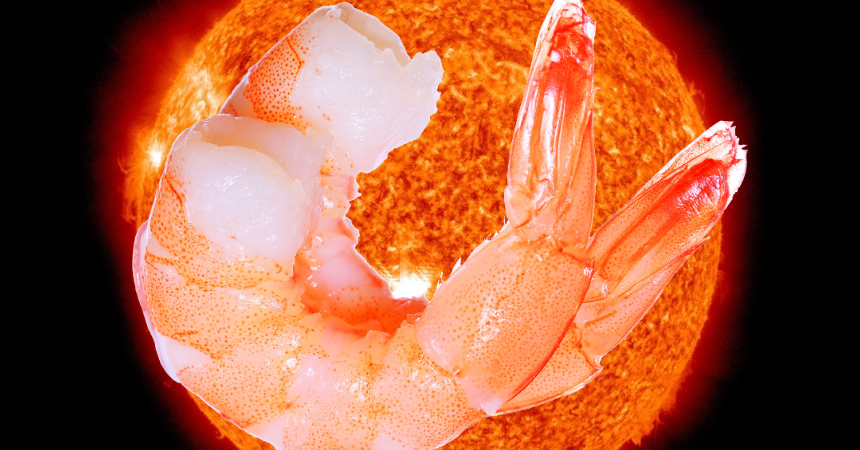
Sun Shrimp Welfare
The supposition that we live in a "goldilocks zone" is frankly just nonsense built up by an anthropocentric need to feel self-important, like Copernicus I am here to rescue us from a self-absorbed disaster of thought. Indeed, what is required for life to form is the ability to create complex structures with causal persistence times above a threshold. With this in mind we are able to find many areas where organisms could persist, if we just had the eyes to see them, namely the Sun! The surface of the Sun is frankly massive, mjx-container[jax="CHTML"] { line-height: 0; } mjx-container [space="1"] { margin-left: .111em; } mjx-container [space="2"] { margin-left: .167em; } mjx-container [space="3"] { margin-left: .222em; } mjx-container [space="4"] { margin-left: .278em; } mjx-container [space
The supposition that we live in a "goldilocks zone" is frankly just nonsense built up by an anthropocentric need to feel self-important, like Copernicus I am here to rescue us from a self-absorbed disaster of thought. Indeed, what is required for life to form is the ability to create complex structures with causal persistence times above a threshold. With this in mind we are able to find many areas where organisms could persist, if we just had the eyes to see them, namely the Sun!
The surface of the Sun is frankly massive, , in contrast consider the habitable region of earth - excluding oceans below photic zones, deserts, and ice caps - which is . The Suns surface exceeds ours by a factor of , so is it not possible there is more to it than meets the eye?
Following Sharma et. al (2023) we are able to define the assembly index, a, of an object as the minimum number of joining steps required to construct it from some basic building blocks. Life, broadly, requires objects where but does not make any assumption about precisely what the base building blocks are. It need not be amino acids, nucleic acids, sugars, carbon, or substances that survive a balmy 5,778 K.
In the solar photosphere there is a diverse set of possible chemistries to access through complex ionized species, magnetic flux tubes, and granular convection cells capable of spanning ~1,000 km a piece. A single supergranulation cell can persist for ~24-48 hours, an eternity by the standards of plasma recombination (). The ratio of structural persistence is thus , an order of magnitude larger than the equivalent ratio for biochemistry on Earth ( for protein folding compared to bond vibrations). The only conclusion is that the solar photosphere is, by our measure, more hospitable to complex structure formation than Earth.
The Sun Shrimp
In this post I have decided to name these creatures Sun Shrimp (Solis caridea), as this is a more cuddly visual that counterweights our own bias towards Earth organisms. We shall define a Sun Shrimp as a self-replicating magnetohydrodynamic structure that satisfies , with a characteristic length scale that is on the order of a granulation cell (~ km) and reproduction time .
As each granulation cell turns over on the timescale min and within each cell the relevant degrees of freedom are ionized species, magnetic field line topologies, and convective flow configurations. We can estimate the number of independent micro-assembly events per granulation turnover conservatively as the number of Debye-length volumes in a granulation cell:
Giving a total rate of trials across the solar surface, assuming 1 million cells, of:
From there we need the probability per trial, we only need one Sun Shrimp to have formed in Sol's 4.6 billion year lifespan (
The groundbreaking paper by Mizuuchi et al. (2023) demonstrated a 20-nucleotide (nt) RNA oligomer that can self-reproduce via template-directed ligation. The naive probability of that occurring is , but Lambert et al. (2025) determined that there are approximately possible autocatalytic RNA sequences. A massive degeneracy in the space of viable self-replicators. As such, even the most pessimistic of estimates requiring specific sequences, our of is 32 orders of magnitude more generous than earth-based abiogenesis achieved with four nucleotide bases, room temperature, and no magnetic confinement.
If you accept that life arose on Earth (which since you are reading this I assume you do), then rejecting the possibility of Sun Shrimp requires you believe that a magnetohydrodynamic self-assembly is harder than biochemistry. A stance that can only be described as carbon-chauvinism.
Sun Shrimp Reproduction
We can estimate a lower bound on \tau_r from the Alfvén crossing time of a granulation cell:
Even given a pessimistic reproduction time of an hour, this would mean a Sun Shrimp could tile the entire solar surface in:
One day.
A single Sun Shrimp could, left to its own devices, tile the surface of the Sun in a single day. But we do not see a uniform monoculture on the surface of the Sun, which tells us something profound, they have predators.
Shrimp Complexity
We have established that Sun Shrimp are likely to have formed, and that their reproduction rate implies a rich ecology. But how complex could a Sun Shrimp be?
The minimum unit of collective behavior in a plasma is the Debye sphere, a volume of radius where electromagnetic interactions are coherent and information can be stored and transmitted. For us, this is the plasma equivalent of a neuron. In the solar photosphere, . A Sun Shrimp, spanning one granulation cell (~), therefore contains a maximum of:
Now consider every neuron on Earth. Humanity contributes ~ neurons (8 billion brains × 86 billion neurons each). But we are not the main event. Earth hosts an estimated insects, each carrying ~ neurons, contributing ~ neurons in aggregate. Adding fish (~ individuals, ~ neurons each), birds (~, ~ each), and other taxa, Earth's total neural budget is approximately neurons.
A single Sun Shrimp has the same number of computational elements as the entirety of Earth's biosphere. With ~ granulation cells on the solar surface, the Sun can host upwards of:
The solar ecosystem is roughly a million times more complex than all life on Earth combined.
The Dyson Sphere, Climate Collapse at Scale
Any utilitarian framework that weighs moral patient-hood by their capacity for complex experience should find this intriguing. If these computational elements map even loosely to experiential capacity, and we have no principled reason to assume they do not, then Sol's biosphere contains the possibilities of a million Earths.
To power earth and our many possible projects we have conceived of the Dyson sphere, a means of enclosing a star to harvest its radiative output. Like the amazon, we wish to take the resources but as enlightened beings we must consider the ramifications. The granulation cells that act as Sun Shrimp habitats are driven by a precise balance of radiative transport, convective instability, and magnetic field structures on the solar surface. The introduction of a massive surface harvesting energy would disrupt this by:
- Alteration of the radiative boundary condition; changing the amount of radiation reflected by solar panels would disrupt the delicate balance of temperature and pressure that maintains the thermal gradients driving granulation.
- Disruption of the magnetic field topology; the conductive shell of a Dyson sphere would interact with the magnetic flux at the surface, disrupting the ecological infrastructure by paving the proverbial paradise to build a parking lot
We would be annihilating an ecosystem that contains a million times the complexity of our own. Indeed we should be horrified by any suggestion of modifying the solar surface for our own sick gain. We should instead work to preserve the solar surface and determine methods that allow us to keep our moral fiber intact as we move into our technological future.
So, the next time someone asks you "Have you heard of a Dyson sphere?" ask them "Have you heard of a Sun Shrimp?"
Sign in to highlight and annotate this article

Conversation starters
Daily AI Digest
Get the top 5 AI stories delivered to your inbox every morning.


Knowledge Map
Connected Articles — Knowledge Graph
This article is connected to other articles through shared AI topics and tags.
More in Products


Flipboard just launched Surf, its new social app and feed reader
Surf is a slightly hard app to explain. It's sort of three things: a client for fediverse apps like Bluesky and Mastodon; a feed reader that lets you subscribe to almost any website, podcast, or YouTube channel; and a tool for creating and following feeds of interesting content, a la Flipboard magazines. It's a browser [ ]

Discussion
Sign in to join the discussion
No comments yet — be the first to share your thoughts!