
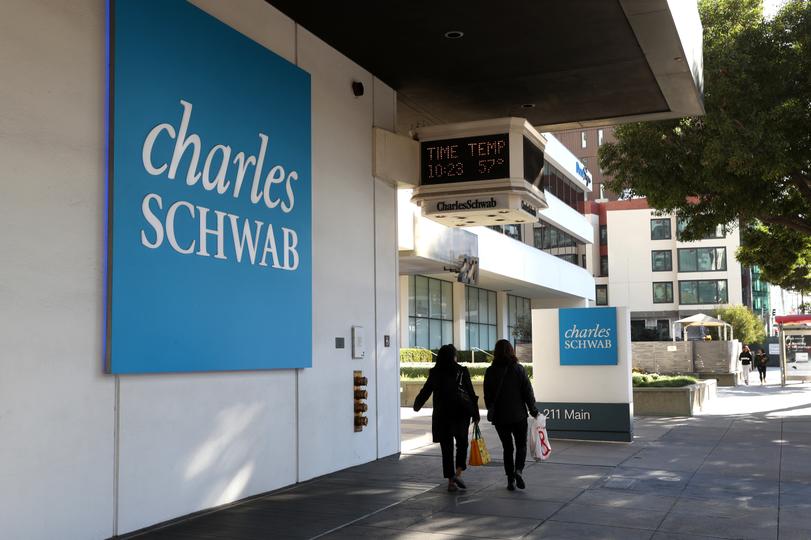
Schwab plans spot bitcoin, ether trading launch in first half of 2026
The financial services giant with almost $12 trillion in client assets is moving closer to direct crypto trading, offering subscription for early access to the Schwab Crypto account.
The financial services giant with almost $12 trillion in client assets is moving closer to direct crypto trading, offering subscription for early access to the Schwab Crypto account.
Apr 3, 2026, 7:18 p.m.
Make preferred on
Brokerage services giant Charles Schwab plans to roll out spot cryptocurrency trading in the first half of 2026, pushing it deeper into digital assets.
"We remain on track to launch our spot crypto offer in the first half of 2026, starting with bitcoin BTC$66,871.28 and ether (ETH)," a company spokesperson told CoinDesk on Friday.
The firm has opened a waitlist for clients seeking early access to what it calls a "Schwab Crypto" account, which will allow users to buy and sell the two largest cryptocurrencies. The firm will offer the service via Charles Schwab Premier Bank, SSB.
The move builds on comments from CEO Rick Wurster, who said last July that Schwab aimed to introduce crypto trading "sometime soon" in response to client demand. He framed the effort as a way to bring digital assets into the same account view as stocks and bonds in a push toward a more unified investment platform.
Schwab's scale could give it an edge as it enters a market long dominated by crypto-native exchanges. The firm reported $11.9 trillion in client assets in 2025, offering a built-in base of retail and institutional investors who may prefer trading crypto within a familiar brokerage environment rather than using standalone platforms.
The firm already allows clients to invest in ETFs linked to cryptocurrencies and trade bitcoin futures on its platform. It also launched the Schwab Crypto Thematic Index (STCE), an ETF that tracks the performance of companies linked to the digital asset sector.
More For You
Most crypto privacy models weaken as blockchain data grows. Encryption-based models like Zcash strengthen. CoinDesk Research maps the five privacy approaches and examines the widening gap.
Why it matters:
As blockchain adoption scales, the metadata available to machine learning models scales with it. Obfuscation-based privacy approaches are structurally degrading as a result. This report provides a comprehensive comparison of all five major crypto privacy architectures and a framework for evaluating which models remain durable as AI capabilities improve.
View Full Report
More For You
Prominent blockchain sleuth ZachXBT alleged faster action by Circle could have limited crypto losses, but freezing asset without legal authorization carries legal risks.
What to know:
- After exploiting crypto protocol Drift, the attacker moved about $232 million in USDC from Solana to Ethereum using Circle’s cross-chain transfer protocol.
- Critics like blockchain investigator ZachXBT said Circle could have moved faster to blacklist wallets and freeze funds. But freezing assets without authorization could carry legal liability, Plume general...
Read full story
Sign in to highlight and annotate this article

Conversation starters
Daily AI Digest
Get the top 5 AI stories delivered to your inbox every morning.


Knowledge Map
Connected Articles — Knowledge Graph
This article is connected to other articles through shared AI topics and tags.
More in Releases
![trunk/02711cea997665055814b95264c4dcd8fb605a0a: [torchtitan hash update] update the pinned torchtitan hash (#178727)](https://avatars.githubusercontent.com/u/133916390?s=60&v=4)
trunk/02711cea997665055814b95264c4dcd8fb605a0a: [torchtitan hash update] update the pinned torchtitan hash (#178727)
This PR is auto-generated nightly by this action . Update the pinned torchtitan hash. Pull Request resolved: #178727 Approved by: https://github.com/pytorchbot


Docling Studio — open-source visual inspection tool for Docling pipelines
Hey everyone I built Docling Studio , an open-source visual inspection layer for Docling. The problem: if you’ve used Docling, you know the extraction engine is powerful — but validating outputs means digging through JSON and mentally mapping bounding box coordinates back to the original pages. No visual feedback loop. What Docling Studio does: Upload a PDF, configure your pipeline (OCR engine, table extraction, enrichment) Run the conversion Visually inspect every detected element — bounding boxes overlaid on original pages, element types, content preview on click Two modes: local (embedded Docling) or remote (Docling Serve) Stack: Vue 3 / TypeScript + FastAPI / Python, fully Dockerized (multi-arch), 180+ tests. Why it matters for RAG workflows: without seeing what Docling extracts, it’s
Discussion
Sign in to join the discussion
No comments yet — be the first to share your thoughts!