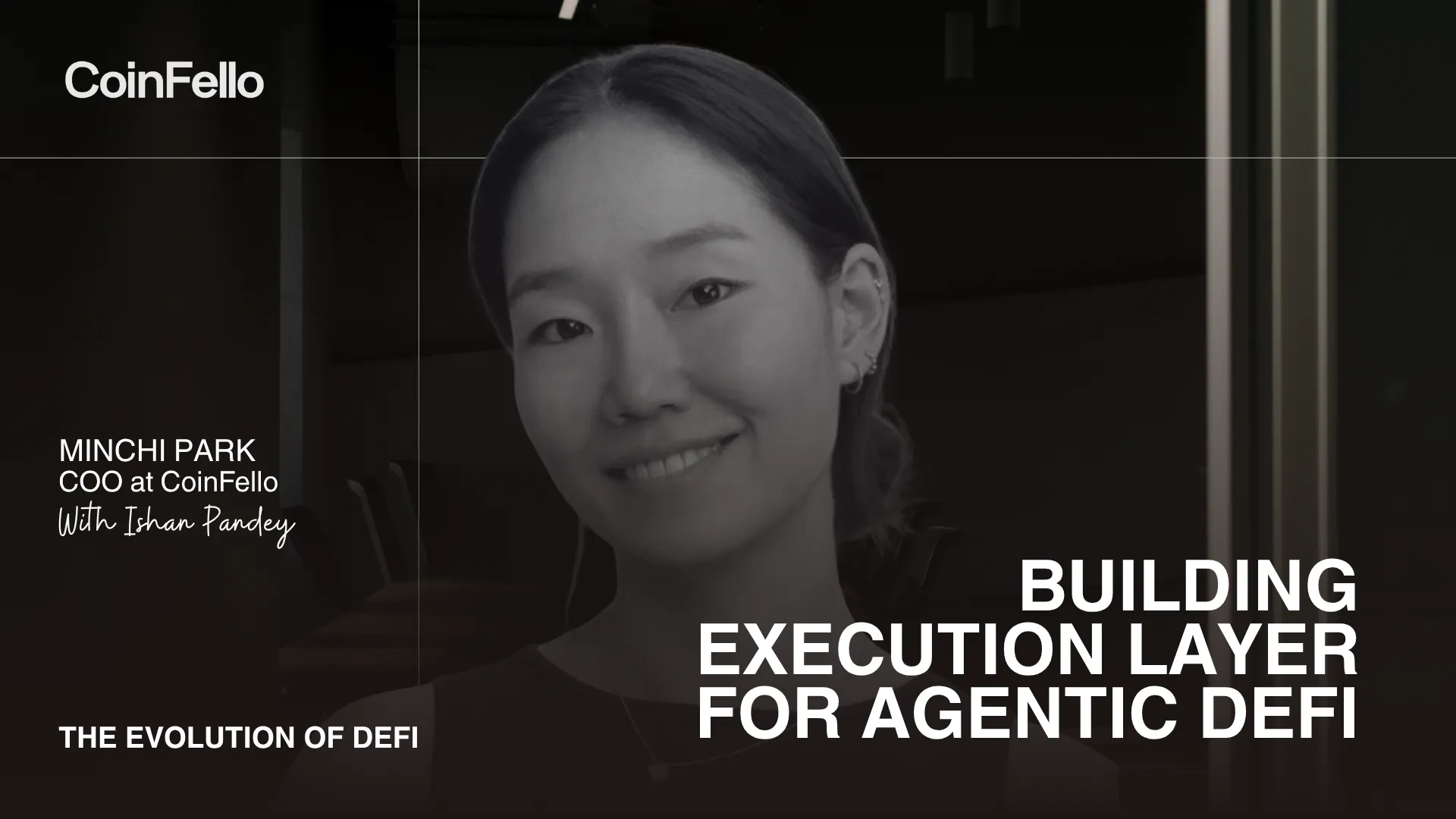
How CoinFello's MinChi Park Built the Trust Layer 500 Million Crypto Users Have Been Waiting For
CoinFello launched publicly at EthCC 2026 with an AI agent that executes DeFi transactions through natural language while keeping private keys on the user's device. The security model uses ERC-7710 scoped delegations — users grant the agent a limited spending permission rather than wallet access, and can revoke it with one action. ETHDenver alpha surfaced two surprises: multilingual demand the team had not anticipated, and developer demand to use CoinFello as an execution layer for third-party agents. The B2B infrastructure angle, enabling Claude Code, Windsurf, and OpenClaw agents to call CoinFello for onchain execution, is now a primary growth thesis alongside the consumer product. Read All
New Story
by
Ishan Pandey
April 1st, 2026
Your browser does not support the audio element.
Speed
Voice
About Author
Building and Covering the latest events, insights and views in the AI and Web3 ecosystem.
TOPICS
Related Stories
Sign in to highlight and annotate this article

Conversation starters
Daily AI Digest
Get the top 5 AI stories delivered to your inbox every morning.
More about
claudemodellaunch
Unlocking the Future: Sourcing Essential Components like the LM317 & ATtiny85 Online for Your Projects
<h1> Unlocking the Future: Sourcing Essential Components like the LM317 & ATtiny85 Online for Your Projects </h1> <p><em>Supply chain strategy from electronics production engineering, 500–50k units/year</em></p> <h2> Introduction </h2> <p>"Order from Digi-Key" is a prototyping strategy, not a production strategy. The 2020–2023 IC shortage demonstrated that supply chain resilience must be designed in — not improvised when lead times hit 52 weeks.</p> <h2> The Sourcing Tier Structure </h2> <div class="table-wrapper-paragraph"><table> <thead> <tr> <th>Tier</th> <th>Examples</th> <th>MOQ</th> <th>Price Premium</th> <th>Lead Time</th> <th>Risk</th> </tr> </thead> <tbody> <tr> <td>Authorized dist.</td> <td>Digi-Key, Mouser, Newark</td> <td>1 pc</td> <td>+25–40%</td> <td>1–3 days (stock)</td>

Why SOC analysts get inconsistent results from ChatGPT (and how structured workflows fix it)
<p>If you've ever handed a security alert to ChatGPT and gotten a different answer each time — you've hit the real problem.</p> <p>It's not the model. It's the prompt.</p> <p>Most analysts paste an alert and ask "what do you think?" That's like asking a junior analyst to investigate without a runbook. You'll get something back, but the quality depends entirely on how the question was framed.</p> <h2> The real problem: no structure </h2> <p>Experienced SOC analysts don't wing investigations. They follow a process:</p> <ul> <li>Triage the alert</li> <li>Map to MITRE ATT&CK</li> <li>Check for lateral movement</li> <li>Build a containment recommendation</li> <li>Write a ticket summary</li> </ul> <p>The issue is that most AI-assisted workflows skip steps 2–5 and jump straight to "is this ba
Build Your Own AI-Powered Wearable with Claude and ESP32
<h1> Build Your Own AI-Powered Wearable with Claude and ESP32 </h1> <p>Imagine glancing at your wrist and having an AI assistant ready to translate foreign languages, analyze your health data, or answer complex questions—all without pulling out your phone. This isn’t a far‑off sci‑fi fantasy; it’s a project you can build for under $15 using off‑the‑shelf components and the power of Claude, Anthropic’s state‑of‑the‑art language model.</p> <p>In this article, I’ll walk you through why putting Claude on a wearable makes sense, what hardware you need, and how the software pipeline works. Whether you’re a curious hobbyist or a developer looking to explore edge AI, you’ll finish with a clear roadmap to create your own AI-powered wrist device.</p> <h2> Why Claude on Your Wrist? </h2> <p>Most smar
Knowledge Map
Connected Articles — Knowledge Graph
This article is connected to other articles through shared AI topics and tags.
More in Models
Why SOC analysts get inconsistent results from ChatGPT (and how structured workflows fix it)
<p>If you've ever handed a security alert to ChatGPT and gotten a different answer each time — you've hit the real problem.</p> <p>It's not the model. It's the prompt.</p> <p>Most analysts paste an alert and ask "what do you think?" That's like asking a junior analyst to investigate without a runbook. You'll get something back, but the quality depends entirely on how the question was framed.</p> <h2> The real problem: no structure </h2> <p>Experienced SOC analysts don't wing investigations. They follow a process:</p> <ul> <li>Triage the alert</li> <li>Map to MITRE ATT&CK</li> <li>Check for lateral movement</li> <li>Build a containment recommendation</li> <li>Write a ticket summary</li> </ul> <p>The issue is that most AI-assisted workflows skip steps 2–5 and jump straight to "is this ba
I’m Suing Anthropic for Unauthorized Use of My Personality
Last year, I was sitting in my favorite coffee shop Caffe Strada, sipping on a matcha latte and writing a self-insert fanfic about how our plucky protagonist escapes the mind-controlling clutches of an evil anti-animal welfare company, when I came across an interesting article on AI character . The core argument is that when you train an AI to be helpful, honest, and ethical, the AI model doesn’t just learn those rules as abstract instructions. Instead, it infers an entire persona from cultural signals in the training data : Why are [AI Model Claude’s] favorite books The Feynman Lectures ; Gödel, Escher, Bach ; The Remains of the Day ; Invisible Cities ; and A Pattern Language ?[...] A good heuristic for predicting Claude’s tastes is to think of it as playing the character of an idealized
Preliminary Explorations on Latent Side Task Uplift
TL;DR . This document presents a series of experiments exploring latent side task capability in large language models. We adapt Ryan’s filler token experiment into a more AI Control-like setup with main task and side task and find that Claude Opus 4.5 can solve harder arithmetic problems latently when it has a longer trajectory. This shifts its 50% accuracy threshold from ~5-step to ~6-step problems after 240 lines of irrelevant output. However, we don’t observe strong evidence to believe that current generation of models generally benefit much from wider parallel compute enabled by longer trajectories with the exception of Opus 4.5. Code is made available here GitHub . Longer Agent Outputs Can Increase Side Task Capability. Claude Opus 4.5's latent arithmetic accuracy as a function of pro
BIAN: estructurando el negocio bancario y su encaje con DDD y microservicios
<p>En los últimos años, el sector financiero ha vivido una transformación profunda: presión regulatoria, fintechs nativas digitales, APIs abiertas, banca como plataforma y una necesidad constante de modernizar core systems sin detener el negocio. En ese contexto, BIAN (Banking Industry Architecture Network) se ha convertido en una referencia clave para quienes diseñan arquitecturas bancarias modernas.</p> <p>Pero BIAN no es solo “otro framework”. Es una propuesta estructurada para organizar el negocio bancario en dominios bien definidos, con un modelo de servicios estandarizado que conecta de forma natural con prácticas como Domain-Driven Design (DDD) y arquitecturas de microservicios.</p> <p><strong><em>¿Qué es BIAN?</em></strong></p> <p>BIAN es una iniciativa colaborativa creada por banc
Discussion
Sign in to join the discussion
No comments yet — be the first to share your thoughts!