
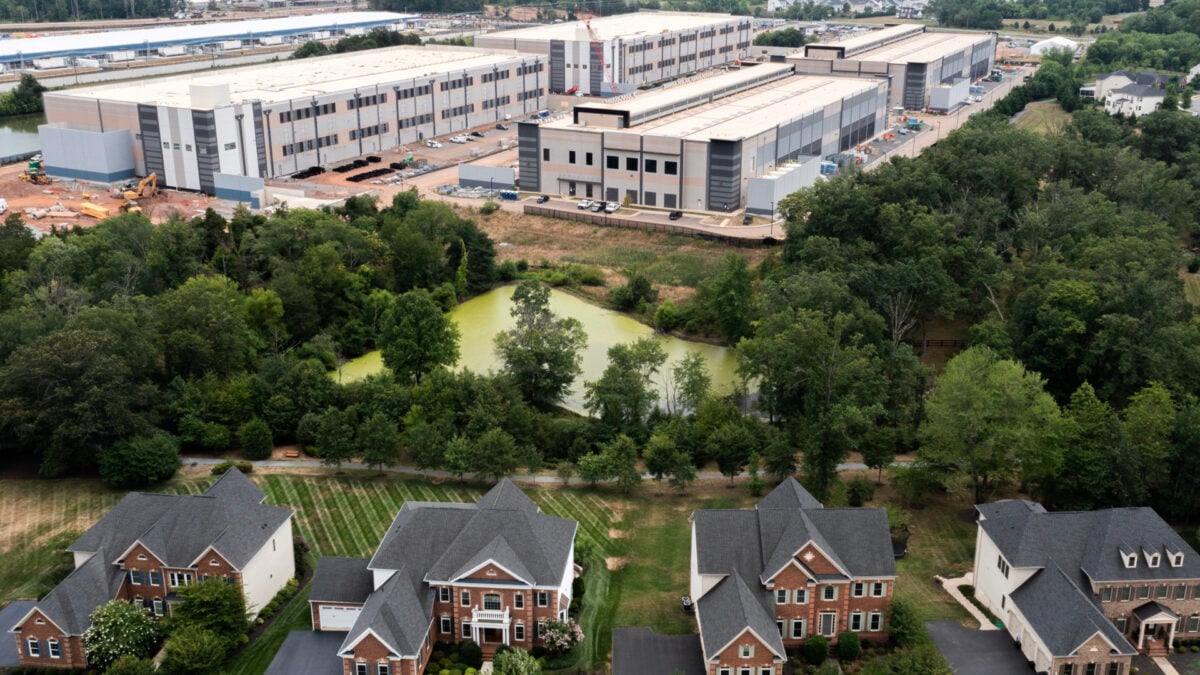
Data Centers Create Heat Islands Stretching 6 Miles, Study Finds
Heat islands can worsen air pollution and increase heat-related deaths.
Data centers have been on the receiving end of increasing public scrutiny, with moratoriums and local protests calling attention to water shortages, higher electricity prices, and deteriorating air quality in the areas around these gargantuan facilities.
Now, researchers say there’s one more thing to add to that list: Data centers might be heating up the entire neighborhood. They dissipate so much heat that they create heat islands within a 6-mile radius of the facility, according to a preprint study by an international group of researchers.
Similar heat islands often exist in city centers, in a phenomenon called the urban heat island effect. Buildings, asphalt, and other city infrastructure tend to trap heat, making cities experience higher temperatures than nearby rural areas. During the daytime, the temperature in urban areas tends to be 1 to 7 degrees Fahrenheit higher than nearby rural areas because of this phenomenon, according to the EPA.
Beyond just causing sweltering temperatures, urban heat islands also affect rainfall patterns, worsen air pollution, and even have a direct, disproportionate link to heat-related deaths, according to some studies.
The researchers behind the new analysis used remote sensing platforms to measure land surface temperatures in areas neighboring AI data centers. Land surface temperature is basically how hot the ground is, not necessarily how hot the air temperature is.
They found that the land in these surrounding areas had gotten 2 degrees Celsius (3.6 degrees F) hotter on average since the data centers began operations. The result has been local microclimate zones, the researchers say, that could impact more than 340 million people worldwide.
“Our results show that the data heat island effect could have a remarkable influence on communities and regional welfare in the future, hence becoming part of the conversation around environmentally sustainable AI worldwide,” the researchers concluded in their paper.
The researchers wrote that some notable temperature increases already recorded could be attributed to this. For example, the data center abundant region of Bajio in Mexico has recorded “serious” land surface temperature increases compared to nearby areas since the data centers began operations roughly 20 years ago, they argue. Similar increases have been observed in Spain’s Aragon province and northeastern Brazil, both of which host a high concentration of data centers.
The world is experiencing a major data center construction boom, with thousands of projects under construction or planned in the United States alone, which means the heat island impact is only going to get more prominent. Data centers and their impact on local temperatures could very well become “an additional factor for environmental and industrial sustainability in the changing climate,” the researchers said.
The solution is twofold, according to the team, concerning both hardware and software. On the hardware side, advances in semiconductor technology and energy material industries could be used to address some of this heat burden. On the software side, developers could redefine the way they create AI systems, focusing resources on integrating energy efficiency and sustainability requirements as a core part of the design.
Gizmodo
https://gizmodo.com/data-centers-create-heat-islands-stretching-6-miles-study-finds-2000741676Sign in to highlight and annotate this article

Conversation starters
Daily AI Digest
Get the top 5 AI stories delivered to your inbox every morning.
More about
study

New Rowhammer attack can grant kernel-level control on Nvidia workstation GPUs
A study from researchers at UNC Chapel Hill and Georgia Tech shows that GDDR6-based Rowhammer attacks can grant kernel-level access to Linux systems equipped with GPUs based on Nvidia's Ampere and Ada Lovelace architectures. The vulnerability appears significantly more severe than what was outlined in a paper last year. Read Entire Article

Summarization model doesn't work
I try to run this below code (provided in Hugging Face’s LLMs course, lesson: Transformers, what can they do?) from transformers import pipeline summarize = pipeline("summarization") summarize( """ America has changed dramatically during recent years. Not only has the number of graduates in traditional engineering disciplines such as mechanical, civil, electrical, chemical, and aeronautical engineering declined, but in most of the premier American universities engineering curricula now concentrate on and encourage largely the study of engineering science. As a result, there are declining offerings in engineering subjects dealing with infrastructure, the environment, and related issues, and greater concentration on high technology subjects, largely supporting increasingly complex scientific
Knowledge Map
Connected Articles — Knowledge Graph
This article is connected to other articles through shared AI topics and tags.



Discussion
Sign in to join the discussion
No comments yet — be the first to share your thoughts!