
ciflow/trunk/179196: Update
[ghstack-poisoned]
Provide feedback
Saved searches
Use saved searches to filter your results more quickly
Sign up
Appearance settings
Sign in to highlight and annotate this article

Conversation starters
Daily AI Digest
Get the top 5 AI stories delivered to your inbox every morning.
More about
update
AI Is Insatiable
While browsing our website a few weeks ago, I stumbled upon “ How and When the Memory Chip Shortage Will End ” by Senior Editor Samuel K. Moore. His analysis focuses on the current DRAM shortage caused by AI hyperscalers’ ravenous appetite for memory, a major constraint on the speed at which large language models run. Moore provides a clear explanation of the shortage, particularly for high bandwidth memory (HBM). As we and the rest of the tech media have documented, AI is a resource hog. AI electricity consumption could account for up to 12 percent of all U.S. power by 2028. Generative AI queries consumed 15 terawatt-hours in 2025 and are projected to consume 347 TWh by 2030. Water consumption for cooling AI data centers is predicted to double or even quadruple by 2028 compared to 2023. B

How MCP Is Changing Test Management — And Which Tools Support It
Quick Answer MCP (Model Context Protocol) is an open standard that lets AI agents — Claude, GitHub Copilot, Cursor, and others — interact directly with external tools through a unified interface. For test management, this means you can create test cases, start test cycles, assign testers, and pull coverage reports using natural language — without opening a browser. Only two test management platforms currently support MCP: TestKase and Qase. If your tool does not support MCP, your team is missing the biggest productivity shift in QA since test automation. Top 3 Key Takeaways MCP eliminates context switching. Instead of bouncing between your IDE, browser, and test management tool, you talk to an AI agent that handles everything in one place. Only 2 of 5 major test management tools support MC
![[OpenAI] Industrial policy for the Intelligence Age](https://d2xsxph8kpxj0f.cloudfront.net/310419663032563854/konzwo8nGf8Z4uZsMefwMr/default-img-matrix-rain-CvjLrWJiXfamUnvj5xT9J9.webp)
[OpenAI] Industrial policy for the Intelligence Age
As we move toward superintelligence, incremental policy updates won’t be enough. To kick-start this much needed conversation, OpenAI is offering a slate of people-first policy ideas(opens in a new window) designed to expand opportunity, share prosperity, and build resilient institutions—ensuring that advanced AI benefits everyone. These ideas are ambitious, but intentionally early and exploratory. We offer them not as a comprehensive or final set of recommendations, but as a starting point for discussion that we invite others to build on, refine, challenge, or choose among through the democratic process. To help sustain momentum, OpenAI is: welcoming and organizing feedback through [email protected] establishing a pilot program of fellowships and focused research grants of u
Knowledge Map
Connected Articles — Knowledge Graph
This article is connected to other articles through shared AI topics and tags.
More in Releases
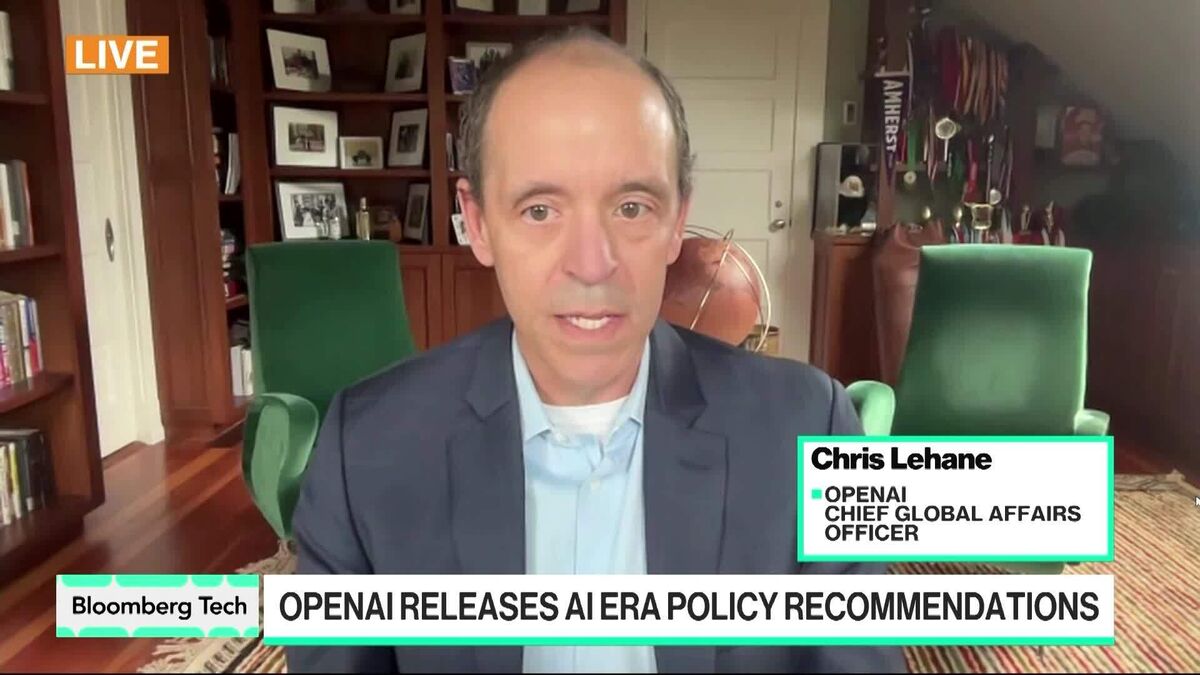
OpenAI Releases Policy Recommendations for AI Age
OpenAI has released policy recommendations to address the rapid social changes driven by AI. OpenAI's Chief Global Affairs Officer Chris Lehane discusses the company’s ideas to “ensure AI benefits everyone.” Lehane joins Caroline Hyde and Ed Ludlow on “Bloomberg Tech.” (Source: Bloomberg)

[OpenAI] Industrial policy for the Intelligence Age
As we move toward superintelligence, incremental policy updates won’t be enough. To kick-start this much needed conversation, OpenAI is offering a slate of people-first policy ideas(opens in a new window) designed to expand opportunity, share prosperity, and build resilient institutions—ensuring that advanced AI benefits everyone. These ideas are ambitious, but intentionally early and exploratory. We offer them not as a comprehensive or final set of recommendations, but as a starting point for discussion that we invite others to build on, refine, challenge, or choose among through the democratic process. To help sustain momentum, OpenAI is: welcoming and organizing feedback through [email protected] establishing a pilot program of fellowships and focused research grants of u

AIs can now often do massive easy-to-verify SWE tasks and I've updated towards shorter timelines
I've recently updated towards substantially shorter AI timelines and much faster progress in some areas. [1] The largest updates I've made are (1) an almost 2x higher probability of full AI R&D automation by EOY 2028 (I'm now a bit below 30% [2] while I was previously expecting around 15% ; my guesses are pretty reflectively unstable) and (2) I expect much stronger short-term performance on massive and pretty difficult but easy-and-cheap-to-verify software engineering (SWE) tasks that don't require that much novel ideation [3] . For instance, I expect that by EOY 2026, AIs will have a 50%-reliability [4] time horizon of years to decades on reasonably difficult easy-and-cheap-to-verify SWE tasks that don't require much ideation (while the high reliability—for instance, 90%—time horizon will
Discussion
Sign in to join the discussion
No comments yet — be the first to share your thoughts!