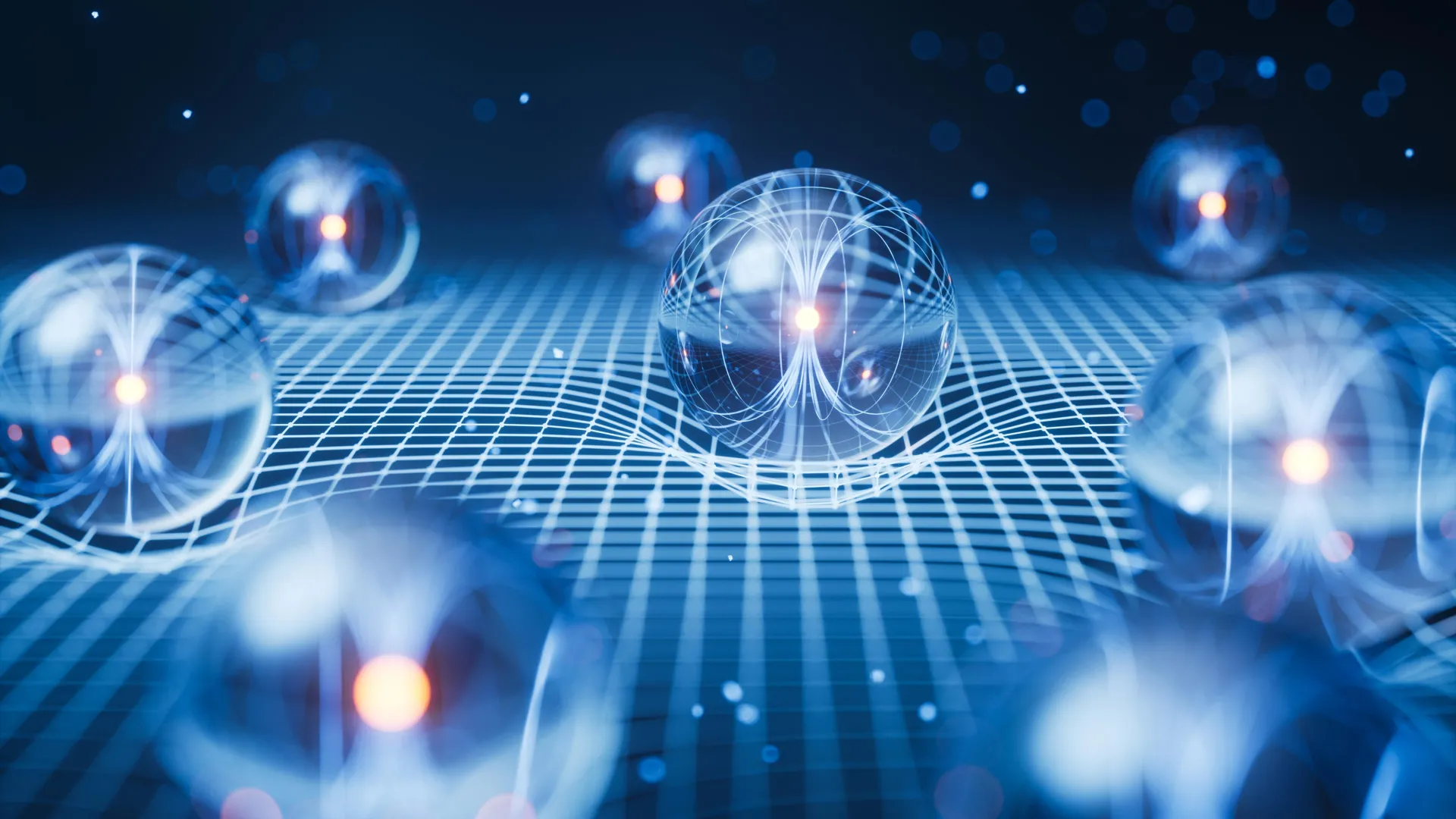
Caltech breakthrough makes quantum memory last 30 times longer
While superconducting qubits are great at fast calculations, they struggle to store information for long periods. A team at Caltech has now developed a clever solution: converting quantum information into sound waves. By using a tiny device that acts like a miniature tuning fork, the researchers were able to extend quantum memory lifetimes up to 30 times longer than before. This breakthrough could pave the way toward practical, scalable quantum computers that can both compute and remember.
While conventional computers store information in the form of bits, fundamental pieces of logic that take a value of either 0 or 1, quantum computers are based on qubits. These can have a state that is simultaneously both 0 and 1. This odd property, a quirk of quantum physics known as superposition, lies at the heart of quantum computing's promise to ultimately solve problems that are intractable for classical computers.
Many existing quantum computers are based on superconducting electronic systems in which electrons flow without resistance at extremely low temperatures. In these systems, the quantum mechanical nature of electrons flowing through carefully designed resonators creates superconducting qubits. These qubits are excellent at quickly performing the logical operations needed for computing. However, storing information -- in this case quantum states, mathematical descriptors of particular quantum systems -- is not their strong suit. Quantum engineers have been seeking a way to boost the storage times of quantum states by constructing so-called "quantum memories" for superconducting qubits.
Now a team of Caltech scientists has used a hybrid approach for quantum memories, effectively translating electrical information into sound so that quantum states from superconducting qubits can survive in storage for a period up to 30 times longer than in other techniques.
The new work, led by Caltech graduate students Alkim Bozkurt and Omid Golami, supervised by Mohammad Mirhosseini, assistant professor of electrical engineering and applied physics, appears in a paper published in the journal Nature Physics.
"Once you have a quantum state, you might not want to do anything with it immediately," Mirhosseini says. "You need to have a way to come back to it when you do want to do a logical operation. For that, you need a quantum memory."
Previously, Mirhosseini's group showed that sound, specifically phonons, which are individual particles of vibration (in the way that photons are individual particles of light) could provide a convenient method for storing quantum information. The devices they tested in classical experiments seemed ideal for pairing with superconducting qubits because they worked at the same extremely high gigahertz frequencies (humans hear at hertz and kilohertz frequencies that are at least a million times slower). They also performed well at the low temperatures needed to preserve quantum states with superconducting qubits and had long lifetimes.
Now Mirhosseini and his colleagues have fabricated a superconducting qubit on a chip and connected it to a tiny device that scientists call a mechanical oscillator. Essentially a miniature tuning fork, the oscillator consists of flexible plates that are vibrated by sound waves at gigahertz frequencies. When an electric charge is placed on those plates, the plates can interact with electrical signals carrying quantum information. This allows information to be piped into the device for storage as a "memory" and be piped out, or "remembered," later.
The researchers carefully measured how long it took for the oscillator to lose its valuable quantum content once information entered the device. "It turns out that these oscillators have a lifetime about 30 times longer than the best superconducting qubits out there," Mirhosseini says.
This method of constructing a quantum memory offers several advantages over previous strategies. Acoustic waves travel much slower than electromagnetic waves, enabling much more compact devices. Moreover, mechanical vibrations, unlike electromagnetic waves, do not propagate in free space, which means that energy does not leak out of the system. This allows for extended storage times and mitigates undesirable energy exchange between nearby devices. These advantages point to the possibility that many such tuning forks could be included in a single chip, providing a potentially scalable way of making quantum memories.
Mirhosseini says this work has demonstrated the minimum amount of interaction between electromagnetic and acoustic waves needed to probe the value of this hybrid system for use as a memory element. "For this platform to be truly useful for quantum computing, you need to be able to put quantum data in the system and take it out much faster. And that means that we have to find ways of increasing the interaction rate by a factor of three to 10 beyond what our current system is capable of," Mirhosseini says. Luckily, his group has ideas about how that can be done.
Additional authors of the paper, "A mechanical quantum memory for microwave photons" are Yue Yu, a former visiting undergraduate student in the Mirhosseini lab; and Hao Tian, an Institute for Quantum Information and Matter postdoctoral scholar research associate in electrical engineering at Caltech. The work was supported by funding from the Air Force Office of Scientific Research and the National Science Foundation. Bozkurt was supported by an Eddleman Graduate Fellowship.
Sign in to highlight and annotate this article

Conversation starters
Daily AI Digest
Get the top 5 AI stories delivered to your inbox every morning.
More about
research
Google's TurboQuant saves memory, but won't save us from DRAM-pricing hell
<h4>Chocolate Factory’s compression tech clears the way to cheaper AI inference, not more affordable memory</h4> <p>When Google unveiled <a target="_blank" rel="nofollow" href="https://research.google/blog/turboquant-redefining-ai-efficiency-with-extreme-compression/">TurboQuant</a>, an AI data compression technology that promises to slash the amount of memory required to serve models, many hoped it would help with a memory shortage that has seen prices triple since last year. Not so much.…</p>

Illinois Tech computer science researcher honored by IEEE Chicago Section - EurekAlert!
<a href="https://news.google.com/rss/articles/CBMiXEFVX3lxTE13OVpWMEk1Z3hlMkR2bHNBQ2dkazFwb3VqN3hCa29GWGJvSVlPa00zd2xUakRmYXFqQmc5OWU0eGl4a21FMDAwWUN2Q3p0M3FrbXBkNV8zN0cxaG1s?oc=5" target="_blank">Illinois Tech computer science researcher honored by IEEE Chicago Section</a> <font color="#6f6f6f">EurekAlert!</font>

My Journey to becoming a Quantum Engineer
<p>I have procrastinated on documenting this process for the longest time. But I think i am ready now (maybe). <br> Coming from a front end engineering background, I am fascinated by the work being done by the quantum engineers at IBM. I am not that great with maths and statistics but I believe anything can be learned with tons of practice and consistency. I want to use this platform to hold myself accountable (that is if i don't give up half way and delete all my posts. I'll try not to btw). </p> <p>This is an article describing <a href="https://www.ibm.com/think/topics/quantum-computing" rel="noopener noreferrer">what quantum computing is</a> and some of it's use cases.</p> <p>I became an IBM qiskit advocate late last year and I have been exposed to a lot of resources and networked a bun
Knowledge Map
Connected Articles — Knowledge Graph
This article is connected to other articles through shared AI topics and tags.
More in Research Papers
Illinois Tech computer science researcher honored by IEEE Chicago Section - EurekAlert!
<a href="https://news.google.com/rss/articles/CBMiXEFVX3lxTE13OVpWMEk1Z3hlMkR2bHNBQ2dkazFwb3VqN3hCa29GWGJvSVlPa00zd2xUakRmYXFqQmc5OWU0eGl4a21FMDAwWUN2Q3p0M3FrbXBkNV8zN0cxaG1s?oc=5" target="_blank">Illinois Tech computer science researcher honored by IEEE Chicago Section</a> <font color="#6f6f6f">EurekAlert!</font>

AI maps science papers to predict research trends two to three years ahead - Tech Xplore
<a href="https://news.google.com/rss/articles/CBMie0FVX3lxTE5aTkZYTWdaRDZwTXNRMldpMG1WZ1YzWDZTOHN5M183Z3A1ZTFYbnhEWTdPRmpvZnZFU0xodlRsNWxFaGxTcEpwalhJNmJpQWE5VjhaRS1tOXJIeTc5Z0JNblJ3dFd4WjRYZGJOX0NrWGt6ZmZJVTBpRm5wWQ?oc=5" target="_blank">AI maps science papers to predict research trends two to three years ahead</a> <font color="#6f6f6f">Tech Xplore</font>
AI inspires new research topics in materials science - Nanowerk
<a href="https://news.google.com/rss/articles/CBMiZ0FVX3lxTFBPWlJSM2ExeVQ3LVppTm45NHpEMW9YVkxscThCNDd2OVB0c3J1ZmVCbWNSZWZ0TjZwSzlOdEFXN2UtRk5LU1hxdXd4ZklldGxoM0FZSnhCd19PWkNHQ1ZRVDNwSHNUSk0?oc=5" target="_blank">AI inspires new research topics in materials science</a> <font color="#6f6f6f">Nanowerk</font>
Discussion
Sign in to join the discussion
No comments yet — be the first to share your thoughts!