
2026: The year of throwing my agency at my health (now with added cyborgism)
I have bipolar disorder. I was diagnosed in late 2012 following my one and only severe manic episode. Most psychiatrists would regard me as a resounding success case – I never even remotely come close to suicidal depression, manic delusions of grandeur, impulsive spending, or irresponsible sexual behavior. By standard measures, I am well-adjusted, functional, and successful. Part of this relative success is adherence to appropriate medication, and another part is maintaining good insight [1] into my mental state. Years ago, I defined a personal bipolar index scale to communicate to myself and close ones my mental state. My bipolar index ranges from -10 to +10 and is a subjective self-report. -10 would be a state of extreme suicidal depression. +10 would be extreme mania with complete loss
I have bipolar disorder. I was diagnosed in late 2012 following my one and only severe manic episode. Most psychiatrists would regard me as a resounding success case – I never even remotely come close to suicidal depression, manic delusions of grandeur, impulsive spending, or irresponsible sexual behavior. By standard measures, I am well-adjusted, functional, and successful.
Part of this relative success is adherence to appropriate medication, and another part is maintaining good insight[1] into my mental state. Years ago, I defined a personal bipolar index scale to communicate to myself and close ones my mental state.
My bipolar index ranges from -10 to +10 and is a subjective self-report. -10 would be a state of extreme suicidal depression. +10 would be extreme mania with complete loss of insight, delusions of grandeur, pressured speech, psychosis, etc. 0 is the perfectly balanced state in the middle, neither up nor down.
In the last decade and a half, I don't think I've ever broken out of the -3 to +3 range. -2 to +1 is standard, and more so between -1 to 0.5 most of the time. Really, an extreme success case by typical psychiatric standards.
Yet the disease burden is real. That I calibrated my scale with extreme states thereby compressing my typical states into a narrow range of smaller numbers hides that a -1 for me is a real state of fatigue, low mood, insomnia, and reduced motivation.
My estimate is that holding my other traits fixed, without the bipolar, I would have accomplished 50-100% more in life (for some very hazy subjective sense of what that would mean) and have a lot more of what I value. It's pretty frustrating to feel that way.
Over the years, I've made various concerted efforts to improve my health by various interventions. I call these "campaigns". Unfortunately, periodic bipolar depression states make many habits hard to stick to. Over the last decade and a bit, my past campaigns have not significantly altered my distribution of bipolar states, insomnia, etc. Truthfully, I have felt demoralized about the prospect of improvement.
Yet in 2026, I am more capable than I have ever been. In 2026, I am "20% more of a person" (for some very hand-wavy definitions). In 2026, I can call upon non-negligible intelligences for all kinds of tasks to help me. First in research assistance, and second via personalized LLM-assistant system ("Exobrain") that helps with capture, recall, prioritization, and other executive function tasks. I will describe this in future posts. I wasn't previously poor at executive function, but I'm at least 20% better now.
So, with new powers at my disposal, I have decided that 2026 is the year I throw all my agency at improving my mental states.
Naturally, one of the first things to do to alter something is measure it.
Over the years, I have made various attempts to log my mood. I'd have an app ping me on my phone, or a Google Form automatically pop-up on my computer once a day. I never stuck with it. Notwithstanding that it'd have taken a couple of minutes, invariably I'd start to find it annoying and mindlessly make dismissing the notifications part of my routine.
Example of a daily logging form from many years ago
Between March and September 2021 (~180 days), I logged 91 responses in this form.
Well, if 2026 is the year of throwing my agency at the problem, I've got to do it now. Fortunately, LLMs have made it easier than ever. I'm on a three-month, twice-daily streak – the longest ever – and I'm feeling determined not to lose precious data. I sorely wish I had been tracking over the years.
The system works like this: I say "Hey Exo"[2] and my phone beeps once, and then I begin speaking, "doing my morning logging here, I feel like I got to sleep at 11 and slept pretty solidly with one brief waking, I feel a bit groggy but also a bit activated. Bipolar score -1, though it's a little hard to tell and could be lack-of-sleep tiredness, Mood is -2 to 1, Motivation is 4, Stress is 2-3....". I say "Jarvis"[3] and my phone beeps twice indicating successful end of recording.
The recording is sent to my server, that in turn sends it to Deepgram's transcription API, which in turn feeds the transcript into an LLM API call set up with prompts and tools. The LLM parses the transcript for to-do items and various notes I want created and updated. In particular, daily logging/journaling gets parsed into my Longform Thoughts Journal and the Unified Quantitative Journal[4].
Lastly, a twice-daily cron job runs and makes another LLM call to parse the Unified Quantitative Journal and insert records into a Postgres database table. The Postgres table is then used to display plots within my Exobrain app.
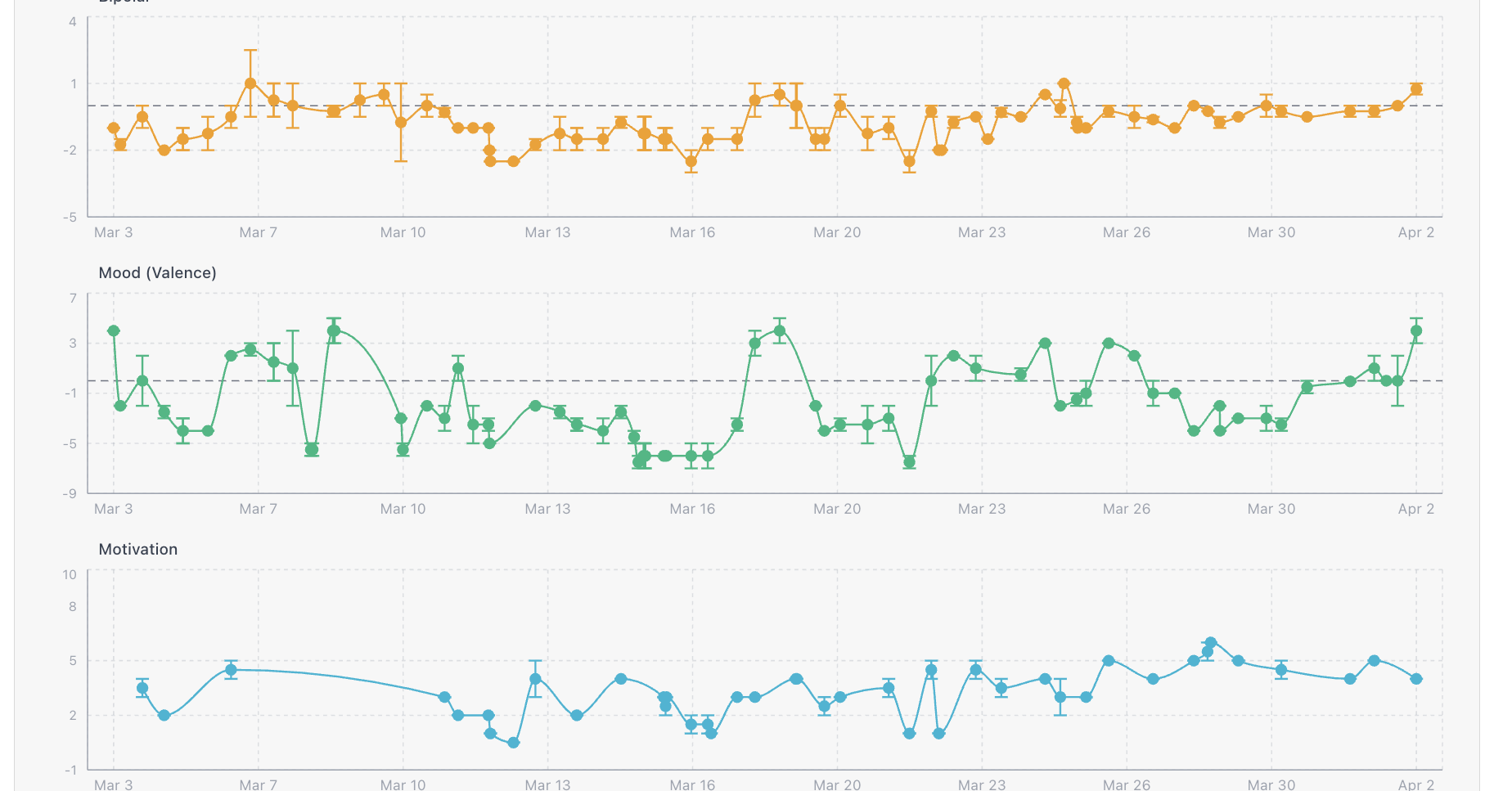
March has been a rough month, in large part due to destabilization introduced by trying a new medication with significant adjustment period. Detailed tracking makes it easier to answer what effect various interventions have. For example, it can be hard to answer "how did the last six weeks feel compared to the preceding six weeks?" Not pictured, but the Exobrain system also makes it easier to track all other relevant details like the dates of dose changes.
More of my subjective quantitative logging
In a future post, I'll describe what I'm measuring in detail, and how the attempt to do so has revealed interesting higher-than-realized dimensionality in my mental states.
In upcoming posts, I will talk more about how I'm targeting my health with agency and agents.
- Describing my Exobrain app and why it's great.
- Detailing my frame that LLMs can be harnessed well when you think of them not doing wholly new things, but making existing affordances vastly cheaper, e.g. I could always write things down – but I didn't because trivial inconveniences. LLMs tip the balance, enabling vastly more writing things down.
- Describing how daily quantitative logging of my mental states on its own increased my awareness of the rich detail and dimensionality in those mental states.
- Analyzing my genome with 4.6 and 5.4 (spoiler: I have a weird drug metabolism profile).
- Exploring methods for getting trustworthy results out of LLMs when you are not a domain expert such as debate and preregistration.
Thank you to Inkhaven for the opportunity to write more.
- ^
Insight is a technical term within psychiatry meaning that a patient is aware of their altered mental status, e.g. a patient with mania who knows they are manic vs one who insists that they're activated simply because everything is super awesome and there's no problem at all.
- ^
Short for Exobrain
- ^
I use Picovoice within my Exobrain app as always-on listening for trigger words. On the free plan, you can train one custom wake-word per month. I spent that on "Hey Exo", leaving me to choose from preset wake words for conclude recording, the options were "Google", "Alexa", "Bumblebee", "Terminator", and "Jarvis". Despite Claude's suggestion of "Terminator", I chose "Jarvis". So now I say Jarvis a couple times a day and it's pretty good. Two syllables I wouldn't otherwise be saying.
- ^
Other recurring logs are the Medication Log, Exercise Log, and Food Log.
lesswrong.com
https://www.lesswrong.com/posts/CuTeXRShovP5gDBLy/2026-the-year-of-throwing-my-agency-at-my-health-now-withSign in to highlight and annotate this article

Conversation starters
Daily AI Digest
Get the top 5 AI stories delivered to your inbox every morning.
More about
claudeupdateassistant
research-llm-apis 2026-04-04
Release: research-llm-apis 2026-04-04 I'm working on a major change to my LLM Python library and CLI tool. LLM provides an abstraction layer over hundreds of different LLMs from dozens of different vendors thanks to its plugin system, and some of those vendors have grown new features over the past year which LLM's abstraction layer can't handle, such as server-side tool execution. To help design that new abstraction layer I had Claude Code read through the Python client libraries for Anthropic, OpenAI, Gemini and Mistral and use those to help craft curl commands to access the raw JSON for both streaming and non-streaming modes across a range of different scenarios. Both the scripts and the captured outputs now live in this new repo. Tags: llm , apis , json , llms

scan-for-secrets 0.1
Release: scan-for-secrets 0.1 I like publishing transcripts of local Claude Code sessions using my claude-code-transcripts tool but I'm often paranoid that one of my API keys or similar secrets might inadvertently be revealed in the detailed log files. I built this new Python scanning tool to help reassure me. You can feed it secrets and have it scan for them in a specified directory: uvx scan-for-secrets $OPENAI_API_KEY -d logs-to-publish/ If you leave off the -d it defaults to the current directory. It doesn't just scan for the literal secrets - it also scans for common encodings of those secrets e.g. backslash or JSON escaping, as described in the README . If you have a set of secrets you always want to protect you can list commands to echo them in a ~/.scan-for-secrets.conf.sh file. Mi
Knowledge Map
Connected Articles — Knowledge Graph
This article is connected to other articles through shared AI topics and tags.
More in Products

AI News This Week: April 05, 2026 - A New Era of Rapid Development and Multimodal Intelligence
AI News This Week: April 05, 2026 - A New Era of Rapid Development and Multimodal Intelligence Published: April 05, 2026 | Reading time: ~10 min This week has been nothing short of phenomenal for the AI community, with breakthroughs and announcements that promise to revolutionize the way we develop and interact with artificial intelligence. From building personal AI agents in a matter of hours to the unveiling of cutting-edge multimodal intelligence models, the pace of innovation is not just accelerating - it's transforming the landscape of what's possible. Whether you're a seasoned developer or just starting to explore the world of AI, this week's news is a must-know, offering insights into how technology is making AI more accessible, powerful, and integrated into our daily lives. Buildin

This Week in AI: April 05, 2026 - Revolutionizing Development with Personal Agents and Multimodal Intelligence
This Week in AI: April 05, 2026 - Revolutionizing Development with Personal Agents and Multimodal Intelligence Published: April 05, 2026 | Reading time: ~10 min This week has been incredibly exciting for AI enthusiasts and developers alike. With advancements in personal AI agents, multimodal intelligence, and compact models for enterprise documents, the field is rapidly evolving. One of the most significant trends is the ability to build and deploy useful AI prototypes in a remarkably short amount of time. This shift is largely due to innovative tools and ecosystems that are making AI more accessible to individual builders. In this article, we'll dive into the latest AI news, exploring what these developments mean for developers and the broader implications for the industry. Building a Per

Exploring AI Ethics in Content Creation: Best Practices for Maintaining Authenticity and Originality in 2026
In today's fast-paced world, AI writing tools are your trusted companions in crafting engaging content without compromising on time or quality. However, as we delve deeper into the realm of automated content creation, it's crucial to address ethical concerns that surfaced over the years, particularly those related to authenticity and originality. Embracing Transparency: Clear Disclosure Practices Transparency is the foundation of trust between creators and their audience. To maintain this bond, it's essential to disclose when AI has been used in the content creation process. This can be achieved by including a disclaimer or attribution that acknowledges the involvement of AI writing tools in generating the content. Maximizing Productivity: Top 7 AI-Powered Writing Assistants for Boosting E

Exploring Real-World AI Writing Tools Integration: Best Practices for Seamless Combination in 2026 (Case Study)
In the bustling world of content creation, time is of the essence. That's where AI writing tools come into play, your secret weapons for enhancing productivity while maintaining high-quality output. Today, we delve into the best practices for seamlessly integrating these powerful tools in 2026. Embracing Advanced AI Research Assistants AI research assistants are designed to aid writers, making content creation more efficient and less daunting. These intelligent tools can suggest ideas, generate outlines, and even draft entire articles based on your input. They serve as an extension of your creativity, helping you tackle projects with ease. Maximizing Productivity: Top 7 AI-Powered Writing Assistants for Boosting Efficiency in 2026 provides a comprehensive guide to some of the best AI resea
Discussion
Sign in to join the discussion
No comments yet — be the first to share your thoughts!